Taiwan Deploys ‘Shoot-and-Scoot’ HIMARS Tactics in High-Stakes Taiwan Strait Drills
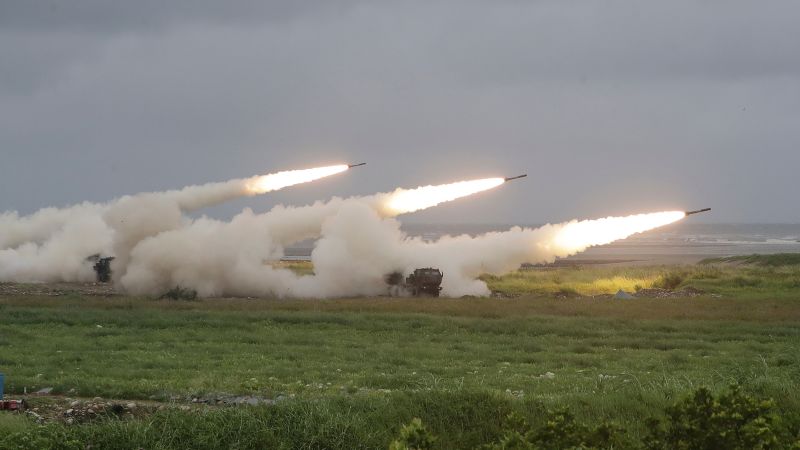
Table of Contents
The Shift to Asymmetric Defense
In a calculated display of precision and mobility, Taiwan’s military recently conducted live-fire exercises on its west coast, deploying the US-supplied High Mobility Artillery Rocket System (HIMARS) to fire into the waters of the Taiwan Strait. While Taiwan has tested these systems previously, this exercise marks the first time the rockets were launched specifically toward the direction of mainland China, turning a technical demonstration into a clear strategic signal.
The drills are a tangible manifestation of a broader shift in Taiwan’s defense philosophy. Moving away from the traditional acquisition of high-cost, large-scale platforms, the island is increasingly adopting an ‘asymmetric’ strategy. This approach prioritizes smaller, highly mobile, and lethal systems that can harass an invading force without requiring the massive infrastructure of a traditional army—essentially aiming to make a potential invasion too costly and chaotic for the People’s Liberation Army (PLA) to sustain.
The ‘Shoot-and-Scoot’ Doctrine
The centerpiece of the exercise was the demonstration of ‘shoot-and-scoot’ tactics. In a modern conflict, any fixed artillery position is quickly identified by satellite or drone surveillance and neutralized by counter-battery fire. To counter this, HIMARS utilizes its truck-mounted mobility to minimize exposure.
During the drills in Taichung, the operational sequence was precise: vehicles maneuvered from concealed positions, deployed their rocket pods, and launched within a three-minute window. Once the rockets were airborne, the launchers immediately retreated to new hiding spots. This rapid cycle of deployment and displacement is designed to keep the battery invisible to enemy sensors and safe from retaliatory strikes.
To avoid escalating tensions into a direct confrontation, the military utilized reduced-range practice rockets. These projectiles are designed to fall into the water relatively close to the coast, ensuring the exercise remains a training event rather than a provocative long-range strike.
Geopolitical Friction and Hardware Logistics
The timing of these drills coincides with a period of intense volatility in the Taiwan Strait. China continues to assert that Taiwan is a renegade province that must eventually be reunited with the mainland, frequently backing these claims with daily incursions of warships and aircraft into Taiwan’s air defense identification zone (ADIZ).
The US, while maintaining a complex diplomatic stance that does not officially recognize Taiwan as a sovereign state, remains the primary supplier of the island’s defensive hardware. However, the flow of this technology is often subject to the whims of high-level diplomacy. In December, the US announced plans to sell an additional 82 HIMARS systems to Taiwan. That package, however, appears to be in a state of flux following recent diplomatic engagements between President Donald Trump and Chinese leader Xi Jinping in Beijing.
Integration with Other Assets
The HIMARS were not operating in a vacuum. The exercises also integrated 155 mm howitzers, creating a layered fire-support network. By combining the precision of the HIMARS with the sustained volume of howitzer fire, Taiwan is simulating a response to a landing operation, focusing on the ability to strike beachheads and troop transports with surgical accuracy before the enemy can establish a foothold.
As Army Sgt. Wang Ming-hui noted during the exercise, the focus remains on maintaining the “strongest force” to protect the island. For Taiwan, the technology isn’t just about the range of the rocket, but the speed of the truck and the invisibility of the operator.