Samsung Floods Indian Market With 72 New AI-Powered TVs, Including High-Stakes Micro RGB Push
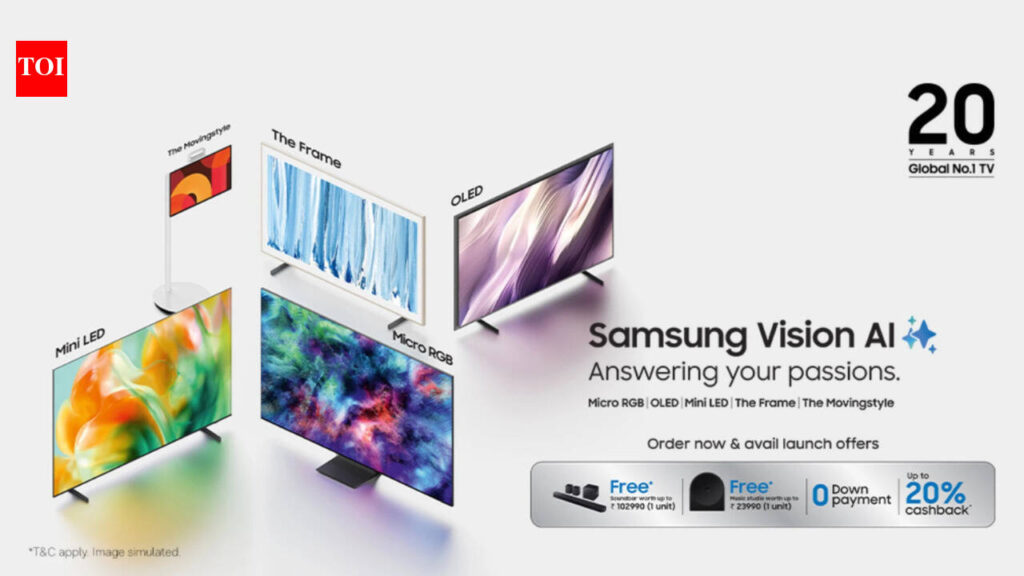
Table of Contents
A Volume Play for the Living Room
Samsung is not merely updating its product catalog for 2026; it is attempting to saturate the Indian home entertainment market. The company has unveiled a massive 72-model onslaught under the ‘Vision AI’ banner, spanning six distinct categories. While the sheer volume of SKUs suggests a strategy to capture every possible price point, the real story lies in the introduction of Micro RGB to the broader Indian consumer base.
The lineup is structured to fight a two-front war. At the bottom, Samsung is defending its territory against aggressive budget brands with entry-level sets starting at ₹36,990. At the top, it is challenging the luxury segment with Micro RGB and QD-OLED panels that push pricing well beyond the ₹1,24,990 mark, targeting the ultra-premium home cinema demographic.
The Micro RGB Gamble
The standout addition this year is the Micro RGB technology. For those unfamiliar, Micro LED and Micro RGB represent the current ‘holy grail’ of display tech—offering the perfect blacks of OLED without the risk of organic degradation or burn-in, while maintaining brightness levels that make standard LEDs look dim. Historically, these sets have been priced as luxury furniture rather than electronics, but Samsung’s move to integrate them into the 2026 Indian lineup suggests a push to make this technology more accessible, albeit still prohibitively expensive for the average buyer.
By flanking Micro RGB with their established Neo QLED and Mini LED ranges, Samsung is creating a tiered hierarchy of ‘brightness.’ Neo QLED continues to serve as the workhorse for bright living rooms, while the new Vision AI enhancements are designed to bridge the gap between hardware specs and actual perceived quality.
AI as the New Baseline
The ‘Vision AI’ branding isn’t just marketing fluff. According to Samsung, the 2026 range utilizes a new suite of neural processing units (NPUs) embedded directly into the SoC (System on Chip). These processors are tasked with real-time upscaling, using AI to predict and fill in missing pixels in low-resolution content—a critical feature for Indian broadcasters who still lean heavily on 1080i or 720p signals.
Beyond the picture, the AI integration extends to acoustic mapping. The TVs are designed to analyze the physical dimensions of the room and the placement of furniture to calibrate sound output. This is a direct play to upsell users on the Samsung ecosystem, with early-bird bundles offering free soundbars to ensure the audio hardware matches the AI-driven visual fidelity.
Market Positioning and Ecosystem Lock-in
Launching 72 different models is a logistical challenge, but it allows Samsung to segment the market with surgical precision. By offering a dizzying array of sizes and panel types, they ensure that no matter the budget—from a small bedroom TV to a 98-inch flagship—there is a Samsung option available. This is a calculated move to increase the footprint of Tizen OS in Indian households, further locking users into the Samsung SmartThings ecosystem.
The competitive landscape in India remains fierce. While LG continues to push its OLED dominance and Xiaomi and TCL fight for the budget sector, Samsung is betting that the combination of AI-enhanced processing and a diverse hardware portfolio will maintain its leadership. For now, the aggressive cashback offers and hardware bundles are designed to clear the path for a strong first-quarter sales cycle.