Apple Backtracks on Liquid Glass Rigidity, Introducing Customization Sliders to Fix Readability Issues
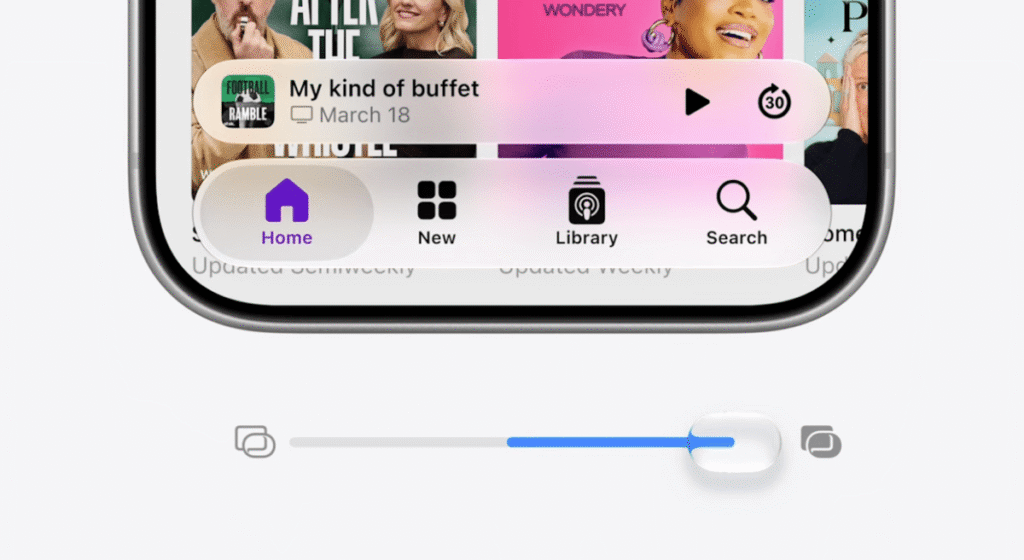
Table of Contents
A Rare Admission of Design Friction
Apple rarely admits when a sweeping design change misses the mark. Usually, the company doubles down on its aesthetic vision, expecting the user base to eventually adapt to the new paradigm. However, the reaction to “Liquid Glass”—the transparent, high-gloss design language unveiled at last year’s WWDC—was too loud to ignore. From accessibility advocates to power users on macOS, the consensus was clear: the sleek, glassy panels looked futuristic but often rendered text unreadable against complex backgrounds.
During Monday’s WWDC 2026 keynote, Apple addressed these frictions head-on. Rather than scrapping the design language entirely, the company is shifting toward a more flexible, iterative approach. The core of the update centers on “foundational’ changes to how Liquid Glass renders depth, moving away from simple transparency toward a sophisticated diffusion system.
Solving the Readability Crisis with Depth Diffusion
The primary complaint regarding Liquid Glass was a lack of contrast. When a transparent window sat atop a busy wallpaper or a colorful app, the text often bled into the background. Apple’s solution is a new diffusion engine that intelligently identifies “complex content” behind the glass layers. By applying a dynamic blur and deepening the separation between content panels, the system creates a more defined visual hierarchy.
This isn’t just a cosmetic tweak; it’s a functional necessity. For users with visual impairments, the original iteration of Liquid Glass presented a significant accessibility barrier. By introducing more aggressive diffusion, Apple is effectively creating a “buffer zone” that ensures text remains legible regardless of what is happening in the background layers of the OS.
The Shift Toward User Agency
Perhaps the most surprising reveal was Apple’s decision to relinquish total control over the aesthetic. In a departure from its usual prescriptive design philosophy, Apple is introducing a transparency slider within the System Settings of both iOS and macOS.
“Since everyone’s preference varies, we’re adding a new slider and settings to adjust Liquid Glass, so you can set it anywhere from ultra-clear to fully tinted,” Apple stated during the presentation. This allows users to manually dial back the “glassy” effect, essentially permitting them to opt-out of the most controversial elements of the design without losing the overall updated framework.
This move mirrors the way Apple handled the transition to “Dark Mode” years ago, acknowledging that while a default aesthetic exists, professional workflows and personal vision requirements necessitate granular control.
Cohesion Across the Ecosystem
To support these changes, Apple is also rolling out a redesigned set of app icons across the board. The goal is to create a more cohesive visual language that complements the diffused glass panels. By refining the saturation and border radii of the icons, the company hopes to pull the fragmented Liquid Glass look together into a singular, polished identity.
For the developer community, the news is equally significant. Apple confirmed that these Liquid Glass customizations will be available via updated APIs at launch. This means third-party apps will automatically inherit the user’s preferred transparency and diffusion levels, preventing a jarring visual disconnect between native system apps and third-party software.
The company framed this pivot as a natural part of the creative process. “Like with all major design updates, there is a natural process where we take a bold leap forward, and then we continue to iterate,” the company noted. It is a rare moment of transparency from Cupertino, acknowledging that the “bold leap” of Liquid Glass required a corrective step to be truly viable for a global audience.


