Lenovo’s CES 2026 Rollables: From ThinkPad’s Vertical Expansion to the Legion’s 2-Foot Gaming Beast
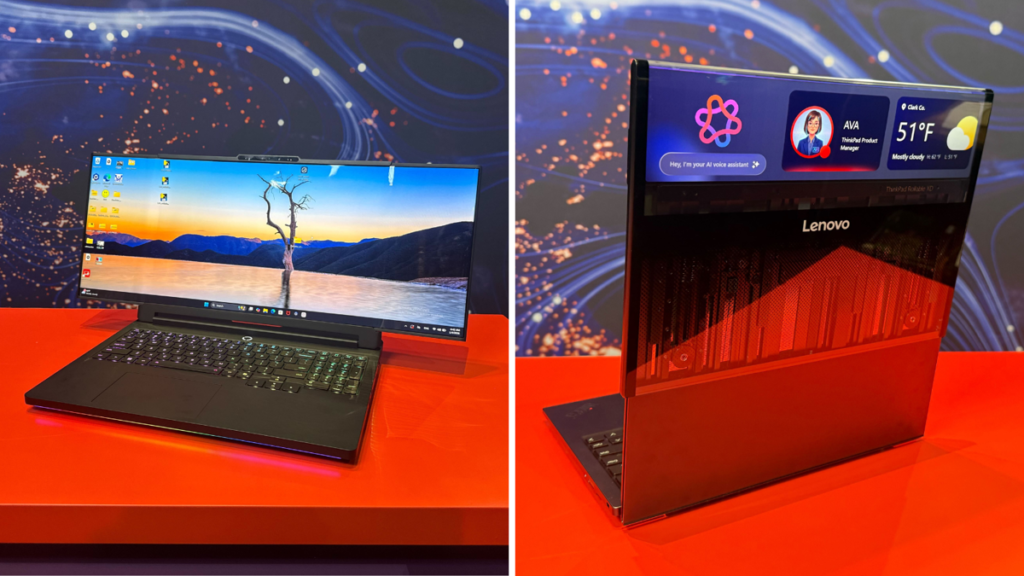
Table of Contents
Beyond the Fold: Lenovo’s New Bet on Rollable Silicon
Six months after the market debut of its first commercial rollable device, Lenovo has returned to CES 2026 with a pair of concepts that push the boundaries of screen real estate beyond the traditional fold. In a private showroom demonstration, the company unveiled the ThinkPad Rollable XD and the Legion Pro Rollable, two prototypes that leverage increasingly flexible OLED technology to solve the perennial struggle of laptop design: the trade-off between portability and screen size.
While Lenovo cautioned that these units are delicate prototypes, the level of polish suggests these aren’t merely imaginative sketches. The engineering focus has shifted from ‘can we make this work’ to ‘how do we make this durable,’ with the company reporting that the current mechanisms are rated for 25,000 roll cycles.
ThinkPad Rollable XD: The Vertical Productivity Play
The ThinkPad Rollable XD focuses on verticality. The display can expand from a standard 13.3-inch form factor to nearly 16 inches in height, effectively increasing the usable screen area by 50% in a matter of seconds. This vertical growth is particularly useful for coding or document review, where vertical scrolling is the primary bottleneck.
The most striking architectural detail is the 180-degree wrap. The OLED panel curves over the top edge of the lid, creating a world-facing secondary display. To protect this vulnerable curve, Lenovo collaborated with Corning to develop a specialized transparent glass cover. This design choice isn’t just for protection; it serves as a window into the device’s internals, exposing the fiber cables and motors that drive the rolling mechanism—a high-tech flex that highlights the mechanical complexity of the chassis.
Interaction with the XD is handled via physical buttons or by swiping across the edge of the lid, which is fully touch-enabled. While previous iterations experimented with voice and gesture controls, the XD leans into more tactile, reliable inputs, suggesting a move toward a more practical business use case.
Legion Pro Rollable: The ‘Arena Mode’ Monster
If the ThinkPad is about productivity, the Legion Pro Rollable is an exercise in sheer gaming ambition. Rather than expanding vertically, this machine grows horizontally. It operates in three distinct states: ‘Focus Mode’ (a standard 16-inch laptop), ‘Tactical Mode’ (expanding to 21.5 inches), and the massive ‘Arena Mode,’ where the display unfurls to a total width of roughly two feet.
This essentially allows a user to deploy an external monitor without actually carrying one. For gamers, this is a more intuitive alternative to the dual-screen setups seen in devices like the Asus ROG Zephyrus Duo, as it maintains a single, contiguous canvas.
The hardware backing this display is formidable. Built on the chassis of the Legion Pro 7i, it is expected to house high-end Intel Core processors and the Nvidia GeForce RTX 5090 GPU. However, this power comes with a physical cost. During demonstrations, the device emitted significant heat even while idling, and the chunky rear vents—trimmed in aggressive RGB lighting—were working overtime to keep the internals cool.
Engineering Hurdles and Reality Checks
The technology isn’t without its flaws. Close inspection of the Legion Pro Rollable revealed superficial skid marks on the OLED panel during the unfurling process, likely caused by the internal drive mechanism. There is also visible, though subtle, creasing where the panel retreats into its housing. These are the exact ‘durability and stability’ hurdles Lenovo must clear before these devices can move from the showroom to the shelf.
There is also the matter of pricing. Given that the ThinkBook Plus Gen 6 Rollable AI entered the market at a steep $3,499.99, any consumer-ready version of the Legion Pro Rollable—with its massive screen and RTX 50-series silicon—will likely command a premium that pushes it deep into the enthusiast-only category.