The Great Migration to Orbit: Why Space-Based Data Centers are Becoming an Industrial Necessity
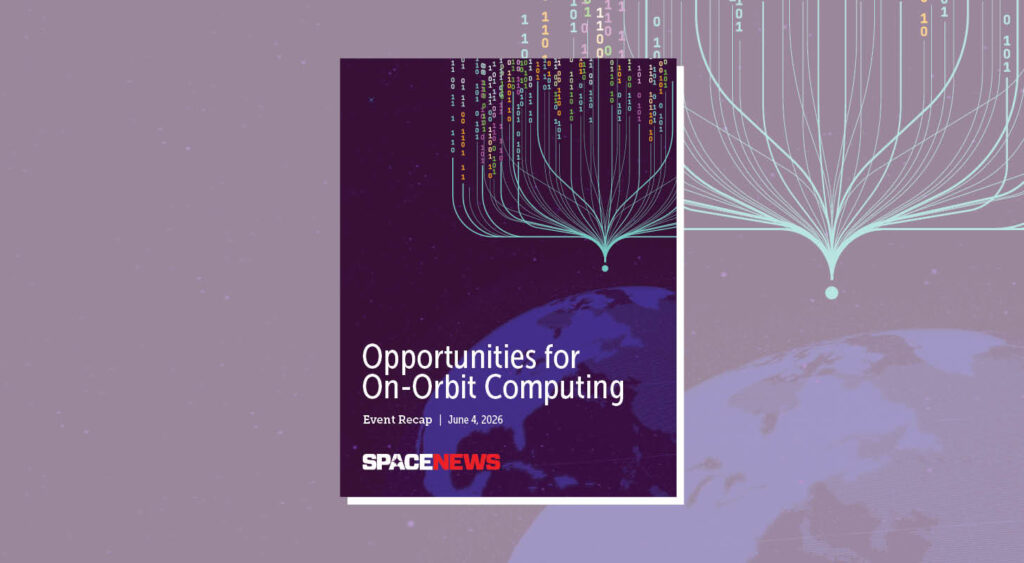
Table of Contents
Moving the Cloud Out of the Atmosphere
For decades, the operational model for satellites has been simple: collect data in space, beam it down to a ground station, and process it on Earth. But as the number of sensors in orbit explodes and the demand for real-time AI analysis grows, this ‘bent-pipe’ architecture is hitting a physical wall. The latency involved in downloading terabytes of raw imagery or telemetry is no longer sustainable for time-sensitive applications.
At a recent industry summit in Washington, D.C., executives from the vanguard of the New Space economy—including representatives from Varda Space Industries, Star Catcher, and Planet—detailed a shift toward on-orbit computing. The goal is no longer just to transmit data, but to treat the vacuum of space as a viable site for high-performance computing (HPC) and data storage.
The Bandwidth Bottleneck and the AI Catalyst
The primary driver for this shift is the proliferation of AI. Modern hyperspectral sensors and high-resolution cameras generate more data than current X-band or Ka-band radio frequencies can realistically handle. If a satellite detects a sudden wildfire or a military movement, waiting for a ground-station pass to process that image can result in a delay of minutes or even hours.
By deploying orbital data centers, companies can implement ‘edge computing’ at the extreme. Instead of sending a raw 1GB image of a forest to Earth, an on-board AI model can process the image in situ and send a few kilobytes of text: ‘Fire detected at coordinates X, Y.’ This radically reduces the load on satellite communications and enables near-instantaneous response times.
The Engineering Hurdles: Heat and Power
Building a server farm in orbit isn’t as simple as launching a rack of Dell servers into a vacuum. Two primary physics problems dominate the conversation: thermal management and power density.
On Earth, data centers rely on massive HVAC systems and water-cooling loops to dissipate heat. In space, there is no air to carry heat away via convection. Everything must be managed through radiation—using massive heat sinks and radiators to bleed warmth into the void. This creates a ceiling on how much compute power can be packed into a single orbital node without the hardware melting itself.
Power is the second constraint. While solar arrays provide a steady stream of energy, the peak power demands of modern GPUs used for AI training and inference are immense. This has led to a surge in interest from firms like Overview Energy and Starcloud, who are exploring more efficient power distribution and storage solutions tailored for the harsh environment of Low Earth Orbit (LEO).
A New Ecosystem of Orbital Services
The emergence of these data centers is giving rise to a secondary economy of space logistics. Companies like Star Catcher and Voyager Technologies are looking at the infrastructure required to maintain these systems. Unlike a traditional satellite, which is designed to be a ‘single-use’ piece of hardware that burns up upon reentry, orbital data centers may eventually require modular upgrades, hardware swaps, and active debris management to ensure longevity.
This transition marks a fundamental change in how we view space infrastructure. We are moving away from isolated satellites and toward an interconnected web of orbiting compute nodes, essentially extending the terrestrial cloud into the thermosphere. As the Aerospace Corporation and other strategic partners continue to refine the regulatory and technical frameworks, the question is no longer if we will have data centers in space, but how quickly we can scale them to meet the appetite of the AI revolution.