Lenovo Pushes OLED Boundaries at CES 2026 With New Vertical and Horizontal Rollable Concepts
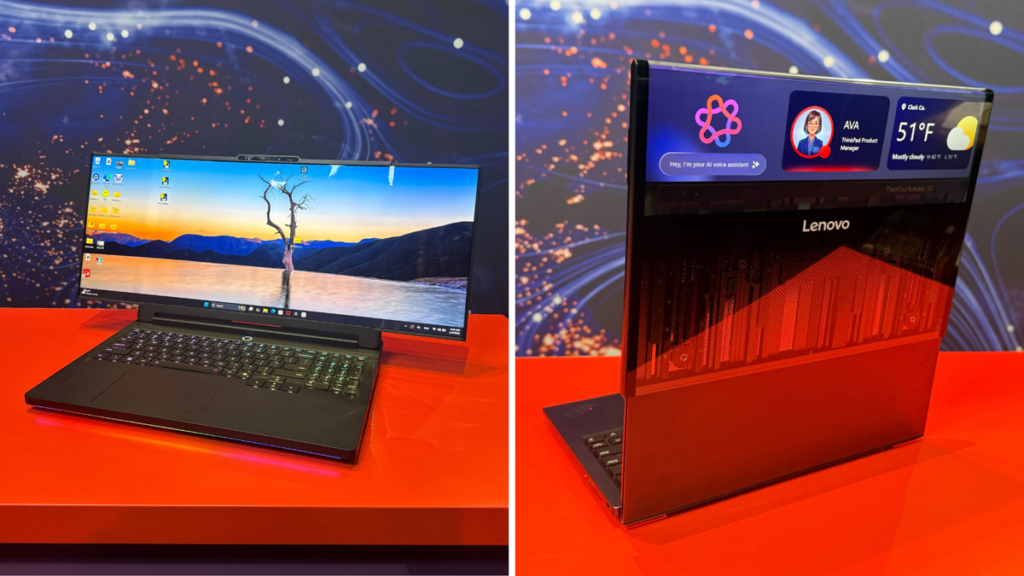
Table of Contents
Beyond the Fold: Lenovo’s New Bet on Elastic Hardware
For the last few years, the industry’s answer to the ‘more screen’ problem has been the fold. From Samsung’s Z Fold series to the various foldable laptops hitting the enterprise market, the crease has become an accepted compromise. At CES 2026, Lenovo is attempting to move past the fold entirely by doubling down on rollable OLED technology.
In a private showroom demonstration, Lenovo unveiled two distinct directions for the future of the PC: the business-centric ThinkPad Rollable XD Concept and the sheer-power Legion Pro Rollable Concept. While both remain prototypes, they represent a sophisticated evolution of the ThinkBook Plus Gen 6 Rollable AI, moving from experimental curiosity to devices that feel nearly consumer-ready.
The ThinkPad Rollable XD: Vertical Expansion and Transparent Engineering
The ThinkPad Rollable XD targets the productivity sector with a display that expands vertically. The screen grows from a compact 13.3 inches to nearly 16 inches in height, providing a 50 percent increase in vertical real estate. This is a direct response to the struggle of multitasking on small laptops, where vertical space is often the primary bottleneck for coding or document review.
The most striking design choice is the 180-degree wrap. The OLED panel doesn’t just stop at the bezel; it curves over the top edge of the lid to create a secondary, outward-facing display. To protect this vulnerable curve, Lenovo collaborated with Corning to develop a specialized transparent glass cover. This choice serves a dual purpose: it protects the hardware while acting as a window into the device’s internals. Observers can see the fiber cables and motors that drive the rolling mechanism—a rare moment of industrial transparency in an era of sealed aluminum chassis.
Interaction on the XD has shifted toward tactile and gesture-based controls. Users can trigger the expansion via a dedicated button or by swiping the edge of the lid. Notably, the voice and hand-gesture controls found in previous iterations have been omitted here, suggesting Lenovo is refining the user interface to prioritize reliability over novelty.
The Legion Pro Rollable: A ‘Tactical’ Approach to Gaming
If the ThinkPad is about efficiency, the Legion Pro Rollable is about immersion. This device utilizes a 240Hz OLED panel that expands horizontally, offering three distinct profiles: ‘Focus Mode’ at 16 inches, ‘Tactical Mode’ at 21.5 inches, and a massive ‘Arena Mode’ that stretches the display to a full two feet.
This effectively creates an integrated external monitor, solving the portability issue for competitive gamers who typically rely on heavy peripherals. Under the hood, the Legion Pro Rollable is expected to mirror the internals of the high-end Legion Pro 7i, likely pairing the latest Intel Core processors with an Nvidia GeForce RTX 5090 GPU.
However, the prototype reveals the inherent challenges of rollable hardware. During demonstrations, slight creasing was visible where the panel retreats into its housing, and superficial ‘skid marks’ appeared on the screen during unfurling. Lenovo claims the mechanism is rated for 25,000 cycles, but the thermal management remains a concern. Even without a game running, the chassis emitted significant heat—a byproduct of packing high-end silicon into a form factor that must accommodate a complex motorized screen system.
The Path to Market
The transition from concept to commerce is the biggest question mark. Lenovo has a track record of bringing these experiments to life; the original rollable concept took two years to hit the market. However, the price of entry remains steep. With the previous ThinkBook Plus Gen 6 retailing for roughly $3,500, these next-generation rollables will likely occupy a luxury niche for early adopters and enterprise power users.
The success of these devices will ultimately depend on the durability of the OLED panels. While the engineering is impressive, the gap between a controlled showroom demo and the rigors of a daily commute is wide. For now, the Rollable XD and Legion Pro serve as a glimpse into a future where the screen size is no longer a fixed specification, but a dynamic choice.


