7.8 Magnitude Quake Hits Southern Philippines, Triggering Tsunami Alerts Across Southeast Asia
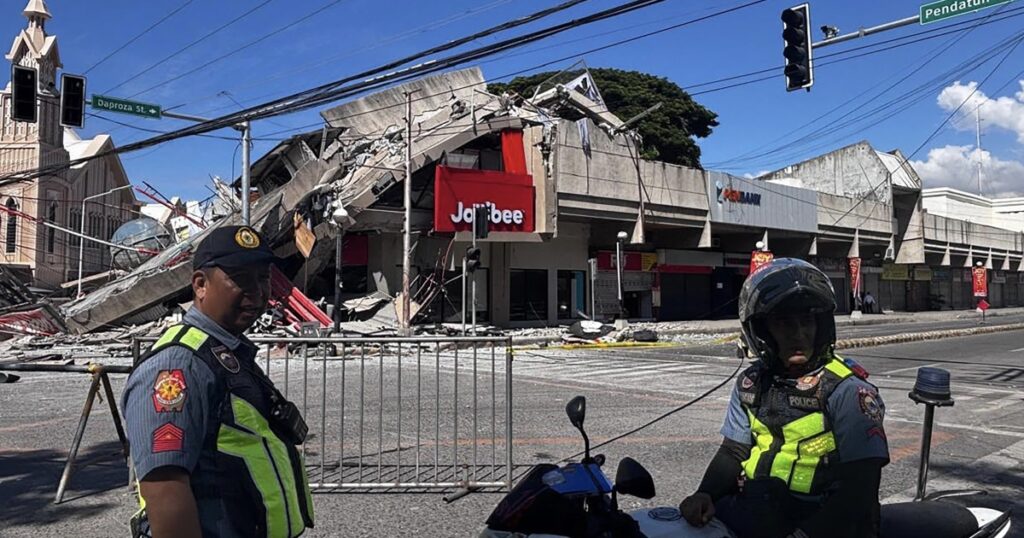
Table of Contents
Seismic Shock in the South
A powerful 7.8 magnitude earthquake struck the waters off the southern Philippines early Monday morning, sending shockwaves through the region and triggering urgent tsunami evacuations across three countries. The quake, which hit at 7:37 a.m., centered just eight miles southwest of General Santos, a critical commercial hub and tuna-processing center with a population exceeding 700,000.
According to Teresito Bacolcol, director of the Philippine Institute of Volcanology and Seismology (PHIVOLCS), the tremor was the result of significant movement within the Cotabato Trench at a depth of 6.2 miles. The intensity of the quake caused immediate structural failures in the urban center of General Santos, where at least one small commercial building collapsed entirely. Footage from the scene showed debris raining down on parked tricycle taxis, while workers at a provincial branch of the DZRH radio station were forced to flee as their four-story office building partially gave way.
Regional Tsunami Escalation
The scale of the seismic event immediately shifted the focus from terrestrial damage to maritime threats. The Pacific Tsunami Warning Center (PTWC) initially cautioned that waves reaching up to 10 feet were possible along certain Philippine coasts. This prompted President Ferdinand Marcos Jr. to issue a direct appeal to citizens in vulnerable areas to abandon their belongings and move to higher ground immediately.
The warnings quickly extended beyond Philippine borders. Malaysia’s Meteorological Department issued a tsunami alert for Sabah state on Borneo, and Indonesian authorities monitored their coastline for incoming surges. These warnings were validated by land-based watch stations in the provinces of Sultan Kudarat and Sarangani, which recorded waves of approximately 3 feet. A gauge off Indonesia’s Sulawesi island corroborated the threat, measuring a 2.7-foot surge.
While smaller sea-level fluctuations were monitored as far away as Japan, Taiwan, and Papua New Guinea, an advisory for Guam was lifted two hours after the initial shock. The PTWC confirmed there was no threat to Hawaii, though the event highlighted the fragility of coastal infrastructure across the western Pacific.
The Ring of Fire Reality
The disparity in initial data—with the U.S. Geological Survey (USGS) measuring the quake at a depth of 34 miles compared to PHIVOLCS’ 6.2 miles—is a common occurrence in the immediate aftermath of major events as different agencies calibrate their sensor arrays. Regardless of the exact depth, the aftermath was marked by a series of violent aftershocks, some reaching magnitude 6.5, which further complicated rescue and assessment efforts.
This event serves as a stark reminder of the Philippines’ precarious geography. Situated along the Pacific “Ring of Fire,” the archipelago sits atop a complex network of seismic faults and volcanic vents. The intersection of this tectonic volatility with an average of 20 tropical storms per year makes the region one of the most disaster-prone areas globally, necessitating a level of civic preparedness and structural engineering that often struggles to keep pace with rapid urban growth in cities like General Santos.
President Marcos Jr. stated that national disaster-response agencies are currently on standby, emphasizing that the government will not “leave Mindanao behind” as the recovery process begins. While there have been no official casualty counts released yet, the collapse of multi-story structures during the early morning hours has left emergency teams searching for potentially trapped individuals in the rubble.