Intel’s Panther Lake Gamble: Hands-on with the MSI Claw 8 EX AI Plus
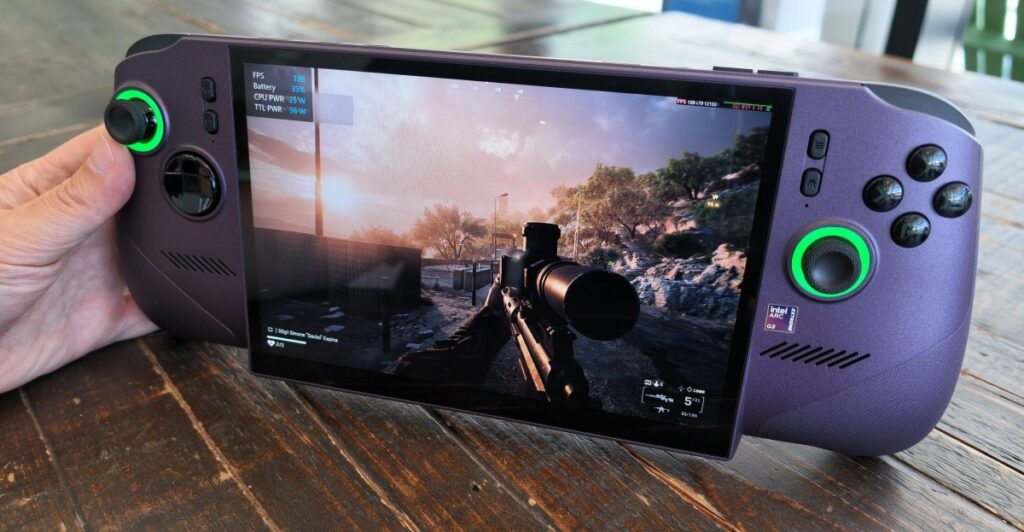
Table of Contents
The Return of Intel in the Handheld Space
For the past few years, Intel has been fighting a defensive war. Between high-profile CPU instability issues, aggressive market encroachment from Qualcomm and Apple in the laptop space, and a general exodus of gamers toward AMD’s Ryzen chips, the company has struggled to maintain its footing. However, the arrival of the Panther Lake architecture—and specifically the 18A process—suggests Intel may have finally found a way to pivot from damage control to offensive leadership.
The primary vehicle for this comeback in the portable space is the MSI Claw 8 EX AI Plus. Spending a few hours with this engineering sample reveals a device that doesn’t just iterate on the previous generation, but attempts to fundamentally shift the efficiency curve of Windows-based handhelds. At the heart of the machine is the Intel Arc G3 Extreme, a chip designed to solve the ‘wattage wall’ that has plagued everything from the ROG Ally to the Steam Deck.
Solving the Power Equation
Handheld gaming has long been a compromise between raw performance and thermal reality. To get AAA titles to run smoothly, most devices have had to push wattage to levels that drain batteries in under two hours. Intel is claiming a paradigm shift here. According to the company, the Arc G3 Extreme can match the performance of AMD’s flagship offerings while consuming nearly half the power. Specifically, Intel asserts that the Claw can deliver the same output at 17 watts that the Xbox Ally X requires 35 watts to achieve.
When pushed to the same 35-watt ceiling, the performance gains are more pronounced. Intel claims an average speed increase of 42 percent, which translates to titles like Cyberpunk 2077, Baldur’s Gate 3, and Forza Horizon 6 running at 1080p (via 2x upscaling) at a stable 60fps. For those prioritizing longevity over fidelity, the chip can reportedly sip as little as 4 watts during light gaming, potentially stretching battery life toward the 12-hour mark.
Real-World Performance: Forza Horizon 6
To test these claims, I ran a comparative side-by-side with the Xbox Ally X and the first-generation Intel Lunar Lake MSI Claw. Running Forza Horizon 6 at a native 1920 x 1200 resolution on medium settings, the results were telling. The Lunar Lake model struggled around 40-45fps, and the Steam Deck was largely unplayable, frequently stuttering even at the lowest specifications.
The new Claw 8 EX AI Plus, however, maintained 60-73fps without the use of frame generation. More importantly, the system power draw hovered around 43W. Combined with the device’s 80-watt hour battery, this suggests a runtime of roughly 1.8 hours at peak performance—marginally better than the Ally X, but achieved with higher visual fidelity and smoother frame delivery.
The experience becomes even more fluid when utilizing Intel’s frame generation. In Battlefield 6, the game hit 110–140fps with 4X frame gen enabled. While the latency makes competitive multiplayer difficult without a mouse and keyboard, the visual smoothness is a testament to the Arc G3’s overhead. After a two-hour session of mixed gaming and photography, the device still retained 29 percent of its battery.
Ergonomics and Build Quality
Beyond the silicon, MSI has clearly listened to the feedback from the original Claw. The 8-inch 120Hz VRR screen is remarkably crisp, and the chassis feels more balanced than its predecessors. The textured grips are a significant improvement, providing a secure hold that mitigates the risk of the device slipping during intense sessions.
There are still some rough edges. The 8-way D-pad feels overly clicky, and the bumpers have a hollow resonance that betrays the device’s mid-range material choices. The triggers and sticks, while using drift-resistant Hall effect technology, still lack the premium tactile feel found in high-end controllers. However, as an engineering sample, these are minor gripes compared to the sheer technical leap provided by the Panther Lake architecture.


