Asus Debuts Ascent QN10: The First Mini PC Powered by Snapdragon X2 Elite
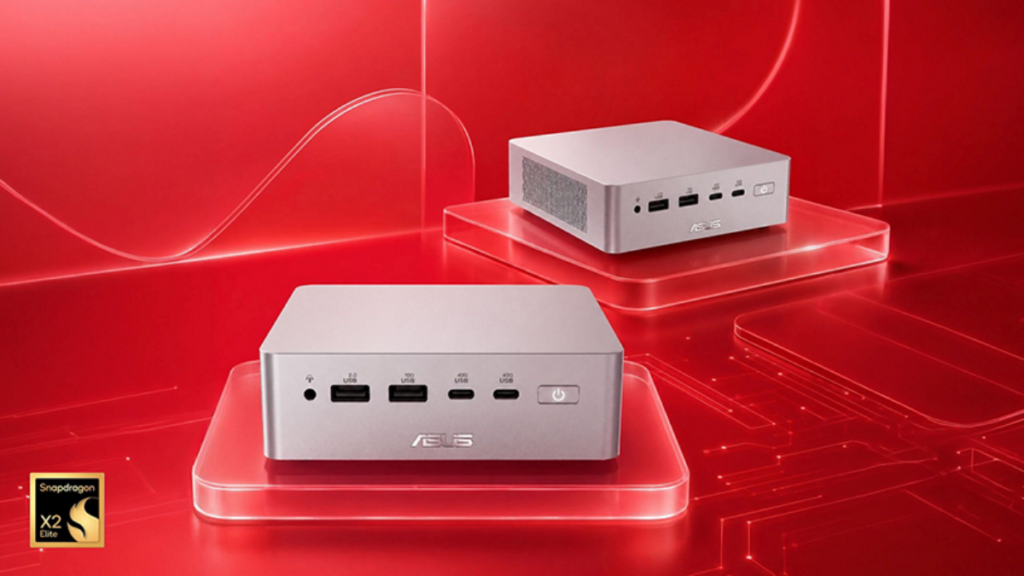
Table of Contents
A New Architecture for the Desktop
At Computex 2026, Asus shifted the conversation around small-form-factor computing by unveiling the Ascent QN10. While the mini PC market has long been a battleground for Intel’s NUC legacy and AMD’s Ryzen chips, the QN10 represents a strategic pivot toward ARM-based architecture. This is the first mini PC to integrate the Qualcomm Snapdragon X2 Elite chipset, a move that signals Asus’s bet on the efficiency and AI capabilities of ARM over traditional x86 processors.
The transition to the X2 Elite isn’t just about power efficiency; it’s about the NPU (Neural Processing Unit). Asus is positioning the Ascent QN10 as more than a compact desktop—it’s being marketed as a dedicated local hub for AI agents. With the NPU capable of delivering up to 80 TOPS (Tera Operations Per Second), the device aims to move AI workloads away from the cloud and directly onto the hardware, reducing latency and improving privacy for developers and power users.
Local AI and the Developer Edge
The most compelling claim accompanying the QN10 is its ability to run complex AI orchestrators and models locally. Asus specifically highlighted compatibility with tools like Claude Desktop, OpenAI Codex, OpenCode, and Cursor, as well as specialized agents like OpenClaw and Hermes. For developers, the ability to run these LLMs (Large Language Models) on a device that fits in the palm of a hand—without relying on an expensive GPU cluster or a persistent internet connection—could be a significant workflow shift.
This focus on “on-device” intelligence reflects a broader trend seen across the industry, where the goal is to minimize the “token cost” and privacy risks associated with cloud-based AI. By leveraging the Snapdragon X2 Elite, Asus is attempting to bridge the gap between the portability of a laptop and the raw capability of a workstation.
Hardware Specifications and I/O
Physically, the Ascent QN10 maintains a conservative, professional aesthetic. The chassis is a rectangular, silver-finished box with flat sides and a focused thermal design, featuring heat exhaust vents positioned on the right side to manage the thermals of the X2 Elite chip.
Despite its small footprint, Asus hasn’t gutted the connectivity. The device features seven I/O ports in total, five of which are conveniently located on the front panel for quick access to peripherals. Under the hood, the machine is surprisingly expandable for a mini PC, featuring four RAM slots that support up to 32GB of LPDDR5x memory. Storage is handled by a 512GB M.2 NVMe PCIe 4.0 SSD, providing the high-speed throughput necessary for loading large AI models into memory.
The Software Hurdle
The QN10 will ship with options for both Windows 11 Home and Windows 11 Pro. However, the success of the Ascent QN10 will likely depend on how well Qualcomm and Microsoft have solved the long-standing compatibility issues with ARM-based Windows. While the Snapdragon X series has made massive strides in emulation, the ability to run legacy x86 software without a performance hit remains the primary friction point for users moving away from Intel or AMD.
Asus has not yet disclosed the pricing or the global release date for the QN10, but its presence at Computex suggests a launch in the coming quarters. If priced competitively, the QN10 could force other OEMs to accelerate their adoption of ARM, potentially ending the x86 monopoly on the mini PC market.


