Blackview’s Mega 5 Tablet Targets the Budget Productivity Market with 12.2-Inch Screen and AI Integration
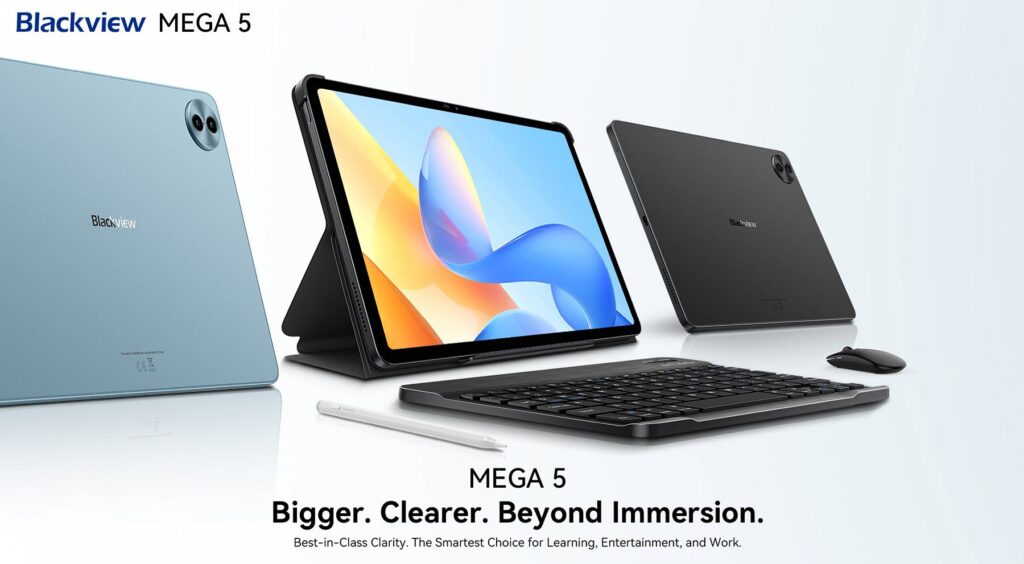
Table of Contents
A Bold Play for the Entry-Level Productivity Space
Blackview is attempting to disrupt the budget tablet market with the launch of the Mega 5, a device that prioritizes screen real estate and a comprehensive accessory ecosystem over raw processing power. Priced aggressively at $216 (with further discounts via coupons), the Mega 5 is positioned not as a high-end workstation, but as a viable alternative for students and light professionals who need more than a smartphone but cannot justify the cost of an iPad Pro or a Samsung Galaxy Tab S series.
The first thing that stands out about the Mega 5 is its physical footprint. Featuring a 12.2-inch display with a 2.4K resolution, the device hits a sweet spot for those who rely on split-screen multitasking. With a pixel density of 236 ppi and a 94.2% screen-to-body ratio, the narrow bezels give it a modern aesthetic that belies its budget pricing. More importantly for long-term users, Blackview has included TUV Low Blue Light certification and Widevine L1, the latter ensuring that users can stream content from Netflix and Disney+ in full HD, a feature often missing from cheaper, off-brand tablets.
Hardware Balance: Practicality Over Power
Under the hood, the Mega 5 utilizes the Unisoc T7300 octa-core processor. While not a powerhouse in the vein of Qualcomm’s Snapdragon 8 series, the T7300 is well-suited for the device’s intended purpose: Office 365 tasks, web browsing, and media consumption. Benchmarks place the chip at approximately 651k points on AnTuTu, which is sufficient for smooth daily operation provided the user isn’t attempting heavy 4K video editing or AAA gaming.
Memory is where Blackview has been particularly generous. The inclusion of 12GB of RAM and 256GB of UFS 3.1 storage means the Mega 5 can handle a significant number of background processes without aggressive app closing. For those needing even more space, a microSD card slot remains available, maintaining the flexibility that power users in the budget segment demand.
The Ecosystem Bundle
Perhaps the most strategic move Blackview has made is the “out-of-the-box” experience. Rather than selling a bare tablet and forcing users to buy peripherals separately, the Mega 5 comes bundled with a stylus, a wireless mouse, a keyboard, a protective case, and screen glass. By transforming the tablet into a pseudo-laptop immediately upon unboxing, Blackview is directly challenging the value proposition of Chromebooks.
Software: AI and the Leap to Android 16
In a surprising software move, the Mega 5 ships with Android 16, layered with Blackview’s DokeOS 5.0. The software is heavily geared toward “PC Mode 3.0,” which allows for up to eight simultaneous tasks and a traditional taskbar interface. This transition from a mobile-first UI to a desktop-style environment is essential for making the 12.2-inch screen useful.
The integration of AI is another core pillar of the Mega 5. DokeOS 5.0 incorporates models from DeepSeek, OpenAI, and Google’s Gemini, allowing users to access generative AI tools directly within the operating system. Whether for summarizing long documents or drafting emails, this layer of AI productivity is designed to bridge the gap between a simple media tablet and a productivity tool.
Powering the experience is a substantial 10,000 mAh battery. Blackview claims this provides up to nine hours of continuous video playback. When the battery does run low, 55W wired charging helps reduce the downtime—a necessary feature given the large capacity of the cell.
With LTE connectivity available, the Mega 5 is designed to be a mobile hub. For $216, it offers a level of hardware and software integration that typically requires a much higher investment, provided the user is comfortable with the mid-range performance of the Unisoc platform.


