POCO Pad C1 Hits Global Markets: Xiaomi’s Budget Play Targets the Media Consumption Gap
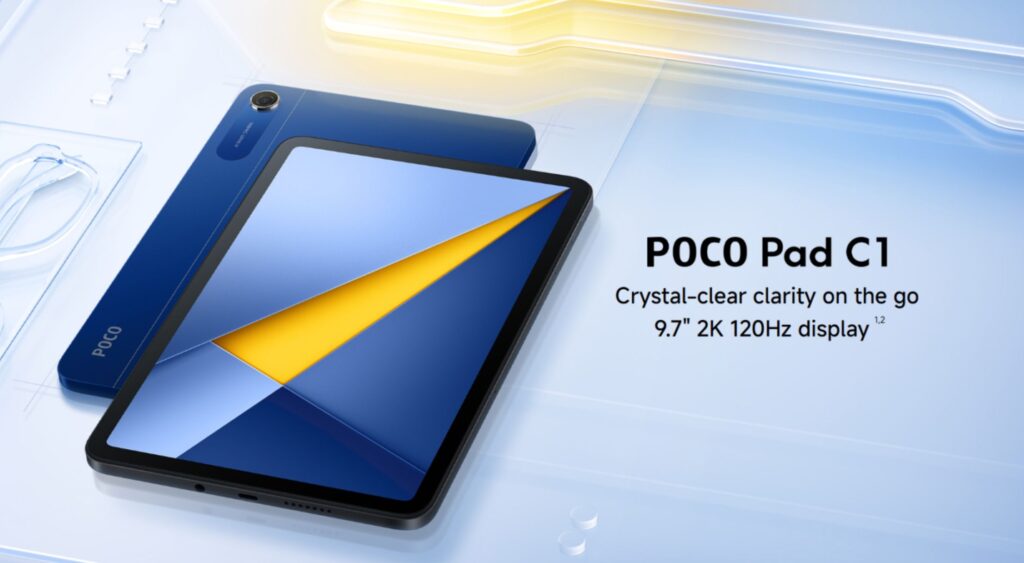
Table of Contents
Filling the Mid-Range Void
Xiaomi has officially expanded its tablet portfolio with the global launch of the POCO Pad C1. Positioned as an accessible entry point into the POCO ecosystem, the C1 isn’t trying to compete with the M-series powerhouses or the high-end iPad Pros. Instead, it is laser-focused on a specific user profile: the casual media consumer who needs a portable screen for streaming, reading, and light productivity without breaking the $300 barrier.
The device arrives at a time when the budget tablet market is increasingly crowded by low-cost competitors, but POCO is betting on a combination of build quality and software integration to differentiate itself. By utilizing a slim metal chassis that measures just 7.4mm and weighs 406 grams, the Pad C1 avoids the ‘plasticky’ feel often associated with sub-$300 Android slates.
Display Quality Over Raw Power
The standout feature of the POCO Pad C1 is undoubtedly its screen. The 9.7-inch IPS panel boasts a 2K resolution, which is a welcome upgrade for a budget device where 1080p is still the norm. More importantly, Xiaomi has equipped the display with a 120Hz refresh rate, ensuring that scrolling through social feeds and navigating the HyperOS 3.0 interface feels fluid.
Brightness levels are sufficient for most indoor environments, peaking at 500 nits, with a boost to 600 nits for outdoor visibility. To appeal to students and heavy readers, the device carries TUV Rheinland certification for low blue light and flicker reduction, reducing eye strain during long PDF review sessions or e-book marathons.
Under the Hood: The Snapdragon 6s Trade-off
While the screen is premium, the internals are strictly utilitarian. The Pad C1 is powered by the Qualcomm Snapdragon 6s 4G Gen 2 chipset. By opting for a 4G-only processor, POCO has kept the cost down and the thermal profile stable, though it means users won’t have access to 5G speeds.
With 6GB of RAM and 128GB of internal storage, the device is built for multitasking between lightweight apps. For those who store large libraries of offline movies or documents, a microSD slot allows for expansion up to 2TB. It is a configuration that makes sense for its price point; it isn’t a gaming rig, but it handles the basics of the modern digital lifestyle with ease.
Software and the AI Pivot
The Pad C1 ships with HyperOS 3.0, Xiaomi’s latest attempt to unify the experience across phones, tablets, and IoT devices. Interestingly, despite its budget hardware, Xiaomi is pushing its AI initiatives onto the C1. The integration of Google’s Gemini and the ‘Circle to Search’ functionality suggests that AI-driven utility is becoming a baseline requirement for Android devices, regardless of the price tier.
On the connectivity and audio front, POCO has made the smart decision to retain the 3.5mm headphone jack—a feature increasingly vanished from the mobile world but essential for a budget media tablet. This is paired with dual speakers, providing a decent stereo image for video playback.
Battery Life and Market Positioning
Powering the device is a 7,600 mAh battery. While 18W charging is slow by modern smartphone standards, the tablet’s efficiency allows for approximately 15 hours of continuous video playback. In a real-world scenario, Xiaomi claims the device can last about 1.7 days of regular use, making it a reliable companion for short trips.
The camera system—an 8MP rear sensor and a 5MP front shooter—is purely functional. These are not devices meant for photography, but rather for scanning documents or the occasional video call.
While final regional pricing is still being rolled out, the Pad C1 is expected to land well under the $300 mark. In doing so, POCO is positioning the C1 not as a laptop replacement, but as a dedicated companion device that bridges the gap between a large smartphone and a full-sized productivity tablet.