Waymo’s Ojai is More Than a Bigger Car—It’s a Play for All-Weather Scaling
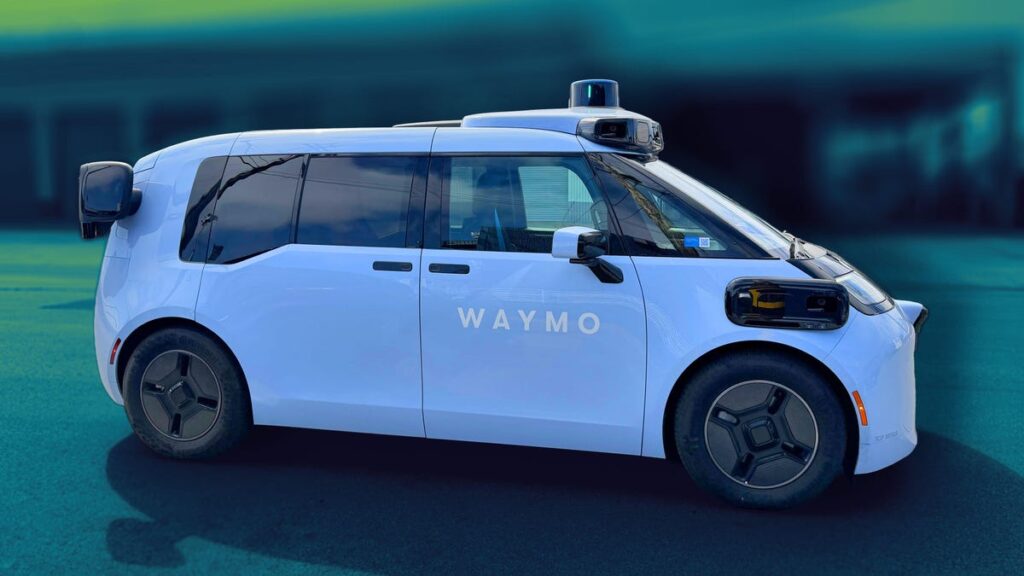
Table of Contents
A Departure from the Jaguar I-PACE
For years, the face of Waymo’s commercial expansion has been the Jaguar I-PACE—a sleek, luxury EV that served the company well as it proved the viability of driverless rides in Sun Belt cities. But the I-PACE always had a fundamental limitation: it was a consumer car adapted for a service, rather than a purpose-built vessel for a utility. Enter the Ojai.
The Ojai, pronounced “Oh, hi,” marks a strategic shift toward specialized hardware. Built on a platform from the Chinese EV manufacturer Zeekr, the Ojai abandons the sporty silhouette of the Jaguar in favor of a boxier, van-like architecture. The result is a cabin that prioritizes utility over aesthetics, featuring a completely flat floor, significantly higher ceilings, and dual-sliding doors that eliminate the ‘door-ding’ anxiety and cramped ingress of traditional sedans.
Inside, the space feels less like a car and more like a mobile lounge. The added legroom isn’t just a luxury; it’s a necessity for a service that aims to replace the traditional Uber or Lyft experience. More importantly, the Ojai is designed with future-proofing in mind. While current models still feature a steering wheel for regulatory or emergency reasons, Waymo has indicated that the Ojai can be modified to remove the wheel entirely, potentially adding a fifth passenger seat and fully realizing the ‘pod’ vision of urban mobility.
Solving the Weather Equation with Gen 6
While the interior is the most immediate change for passengers, the real story is atop the roof. The Ojai debuts the sixth-generation Waymo Driver, a sensor suite specifically engineered to tackle the ‘edge cases’ that have historically kept robotaxis trapped in fair-weather cities like Phoenix and San Francisco.
One of the most telling additions is the inclusion of integrated wipers for the sensor suite. In previous iterations, heavy rain or snow could ‘blind’ the lidar and cameras, forcing vehicles to pull over or operate with severely degraded confidence. By actively clearing the sensors, Waymo is signaling a move toward true all-weather autonomy. According to company data, the Gen 6 hardware provides higher-resolution detection and better object gauging across a wider variety of lighting conditions, which is a prerequisite for expanding into the Northeast or Midwest winters.
This technical leap is essential for Waymo to compete with Tesla’s ambitions for a dedicated Cybercab and the burgeoning competition from Zoox. If the Ojai can reliably navigate a snowy Chicago street as easily as a sunny Phoenix boulevard, the addressable market for autonomous ride-hailing expands exponentially.
The Accessibility Angle
Waymo has quietly leaned into accessibility in a way few other autonomy players have. Inside the Ojai, several control buttons now include Braille, acknowledging a critical user base: blind and visually impaired passengers who view autonomous ride-hailing not as a novelty, but as a primary means of independent mobility.
The vehicle also addresses the practicalities of daily life with a significantly enlarged trunk, capable of handling strollers or large grocery hauls—areas where the I-PACE often felt restrictive. Passengers can manage their environment via a central touchscreen, controlling climate, music, and customer support without needing to interact with a human operator.
Rolling Out the Fleet
The Ojai is currently entering a phased rollout, beginning with the core hubs of San Francisco, Los Angeles, and Phoenix. Waymo is leveraging its app to notify users when they are eligible to request the new vehicle, treating the launch as a living lab to gather data on passenger preferences before a wider summer expansion.
By pivoting to the Zeekr-based Ojai, Waymo is moving away from the ‘modified consumer car’ phase of its evolution. The Ojai represents the transition from a technical demonstration to a scalable transport product, designed specifically to be cleaned, loaded, and operated in environments that would make a standard luxury EV hesitate.


