Lenovo’s ThinkStation P4 Bets Big on Blackwell GPUs and Ryzen 9000 to Capture the Local AI Market
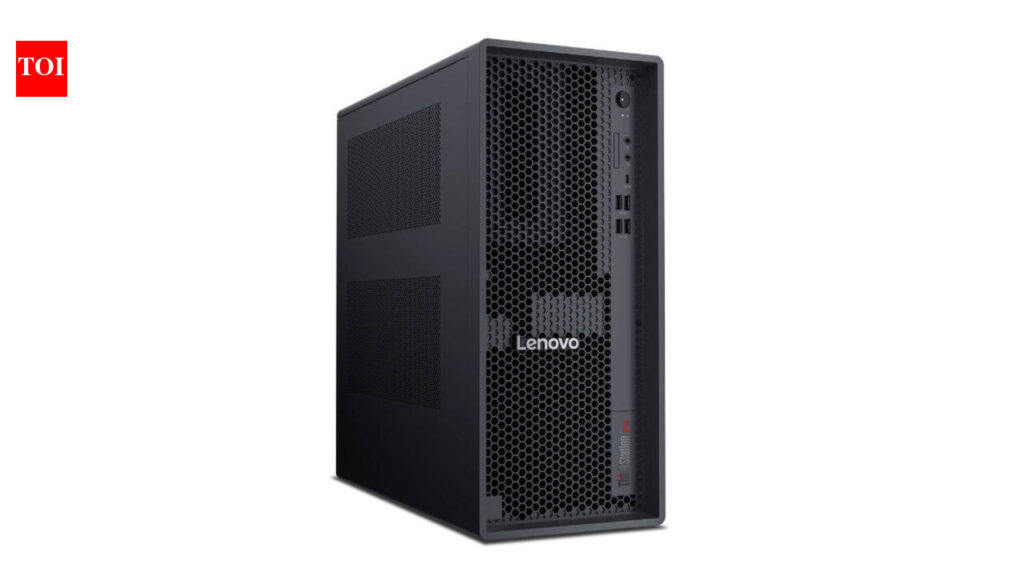
Table of Contents
Hardware for the Local AI Era
Lenovo is pivoting its workstation strategy toward the “edge AI” movement with the launch of the ThinkStation P4. While the industry has largely focused on massive cloud-based clusters for LLM training, the P4 is designed for the individual power user—data scientists, 3D architects, and engineers—who need to run complex inference and model fine-tuning locally without the latency or privacy concerns of the cloud.
The centerpiece of the P4 is the integration of AMD’s latest Ryzen PRO 9000 Series processors. By utilizing 3D V-Cache technology, Lenovo is targeting a specific bottleneck in professional workloads: memory latency. In heavy computational tasks like fluid dynamics or complex rendering, the enlarged L3 cache allows the CPU to store more data closer to the cores, significantly reducing the time the processor spends waiting for data from the RAM.
The Blackwell Advantage
More critical to the P4’s positioning is the inclusion of Nvidia’s RTX PRO 6000 GPUs based on the Blackwell architecture. Transitioning from the previous Ada Lovelace generation, the Blackwell-based cards offer a massive leap in FP4 precision and transformer engine efficiency. This makes the ThinkStation P4 less of a traditional “desktop” and more of a compact AI server.
For professionals working in Generative AI, the Blackwell architecture’s improved tensor core performance means faster iterations on local Stable Diffusion builds or the ability to run quantized versions of Llama 3 with significantly higher tokens-per-second. Lenovo has optimized the chassis to handle the thermal demands of these GPUs, which typically generate substantial heat during prolonged AI training cycles.
Engineering for Stability and Scale
Unlike consumer-grade gaming rigs that often masquerade as workstations, the P4 is built on the PRO platform. This means support for ECC (Error Correction Code) memory, which is non-negotiable for scientists and financial analysts where a single bit-flip could invalidate hours of simulation data. The use of the PRO series CPUs also ensures a longer support lifecycle and enhanced security features integrated at the silicon level.
The machine is designed for modularity, reflecting a trend where professional users frequently swap GPUs as VRAM requirements grow. Given that AI models are ballooning in size, the P4’s internal layout prioritizes airflow and accessibility, allowing for easier upgrades to the power supply or memory banks as the user’s needs evolve.
Contextualizing the Competition
The ThinkStation P4 enters a crowded market, facing direct competition from the HP Z-series and Dell’s Precision line. However, by pairing the high-cache Ryzen 9000 with Blackwell’s architecture, Lenovo is attempting to carve out a niche for users who find a standard PC too weak but a full-blown rack server too cumbersome. It is a strategic move to capture the growing segment of “AI-native” developers who are increasingly moving their workflows from Google Colab and AWS back to local hardware for security and cost reasons.
Availability and specific regional pricing have not been fully detailed, but the P4 is expected to roll out to enterprise partners first before hitting broader professional channels.


