POCO Pad C1 Hits Global Markets: A Budget-Friendly 2K Slate Targeting the Mid-Range Gap
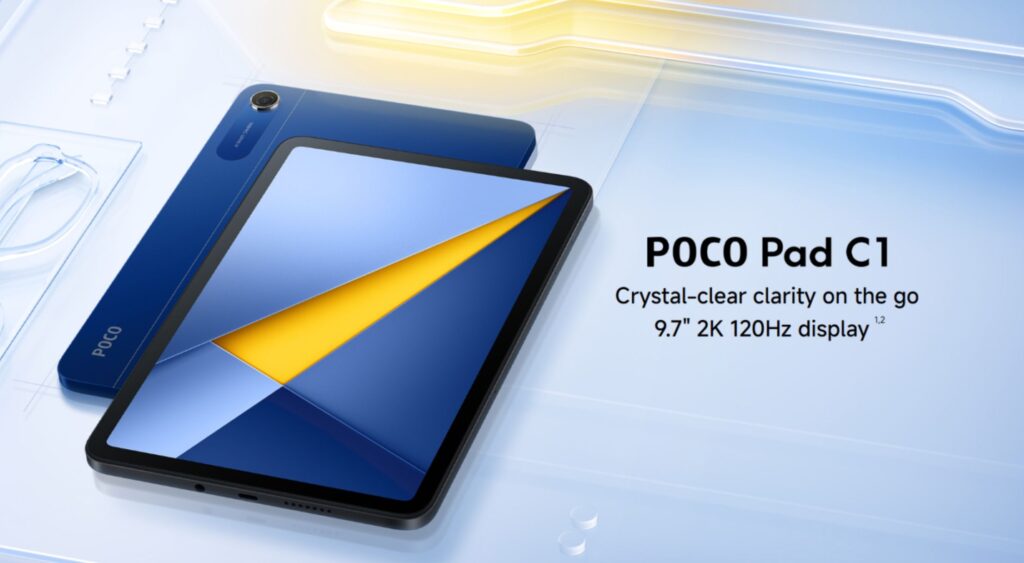
Table of Contents
Expanding the Budget Ecosystem
Xiaomi has officially expanded its tablet portfolio with the global debut of the POCO Pad C1. While the enthusiast market remains focused on high-performance OLED slates and foldable hybrids, the Pad C1 is a calculated play for the ‘everyday’ user—those who need a device for media consumption, light productivity, and student work without crossing the $300 threshold.
The device arrives at a time when the budget tablet market is increasingly bifurcated between extremely cheap, underpowered options and premium Pro models. By landing in the middle, POCO is attempting to offer a “premium feel” through hardware aesthetics while keeping the internals modest enough to remain affordable.
Display and Build: Prioritizing the Visuals
The most striking feature of the POCO Pad C1 is its 9.7-inch IPS display. In a move that deviates from typical budget constraints, Xiaomi has equipped the slate with 2K resolution and a 120Hz refresh rate. This ensures that UI animations and scrolling feel fluid, a stark contrast to the 60Hz panels often found in this price bracket.
To combat the visibility issues common with budget LCDs, the panel hits 500 nits of typical brightness, peaking at 600 nits for outdoor use. The hardware is housed in a slim 7.4mm metal chassis, weighing in at 406 grams. This metallic build provides a structural rigidity that plastic competitors lack, aligning the device with the design language of the more expensive Pad 6 series.
For users concerned with eye strain during long reading sessions, the device carries TUV Rheinland certification for low blue light and flicker reduction, making it a viable candidate for digital textbooks and e-reading.
The Performance Trade-off
Under the hood, the POCO Pad C1 is powered by the Qualcomm Snapdragon 6s 4G Gen 2. It is important to be clear: this is not a gaming machine. The chipset is designed for efficiency and stability rather than raw power. Coupled with 6GB of RAM and 128GB of internal storage, the device is optimized for multitasking between browsers, PDF readers, and streaming apps.
Storage limitations are mitigated by the inclusion of a microSD card slot, supporting expansion up to 2TB. This makes the Pad C1 particularly attractive for users who maintain large offline libraries of movies or documents.
Software-wise, the device ships with HyperOS 3.0. Interestingly, Xiaomi is pushing its AI ambitions down to the budget tier. The Pad C1 includes integration for Gemini and the “Circle to Search” functionality, suggesting that Google’s AI ecosystem is becoming a baseline requirement for Android hardware, regardless of the processor’s clock speed.
Battery Life and Connectivity
Powering the device is a 7,600 mAh battery. While the 18W charging speed is modest by modern standards—meaning users will face a significant wait for a full charge—the efficiency of the Snapdragon 6s chip allows for impressive longevity. Xiaomi claims up to 15 hours of continuous video playback and nearly two days of light, intermittent use.
In a welcome move for the audio community, POCO has retained the 3.5mm headphone jack, sitting alongside dual speakers for a more immersive media experience without the need for Bluetooth latency.
Connectivity is limited to 4G, reflecting the device’s positioning as a value-centric product. While 5G is now standard in mid-range phones, 4G remains sufficient for the bulk of tablet activities, which are predominantly consumption-based.
Market Positioning
While official regional pricing has not been fully detailed across all markets, early indicators suggest the POCO Pad C1 will retail well below $300. By pairing a high-quality 2K screen with a functional, if uninspiring, processor, Xiaomi is targeting the gap between the basic entry-level tablets and the high-end productivity machines.
The 8 MP rear and 5 MP front cameras are utilitarian, designed for the occasional document scan or a low-resolution video call rather than photography, which is standard for this category of device.