OPPO Pad 6 Debuts with 144Hz 3K Display and Dimensity 9500s Silicon
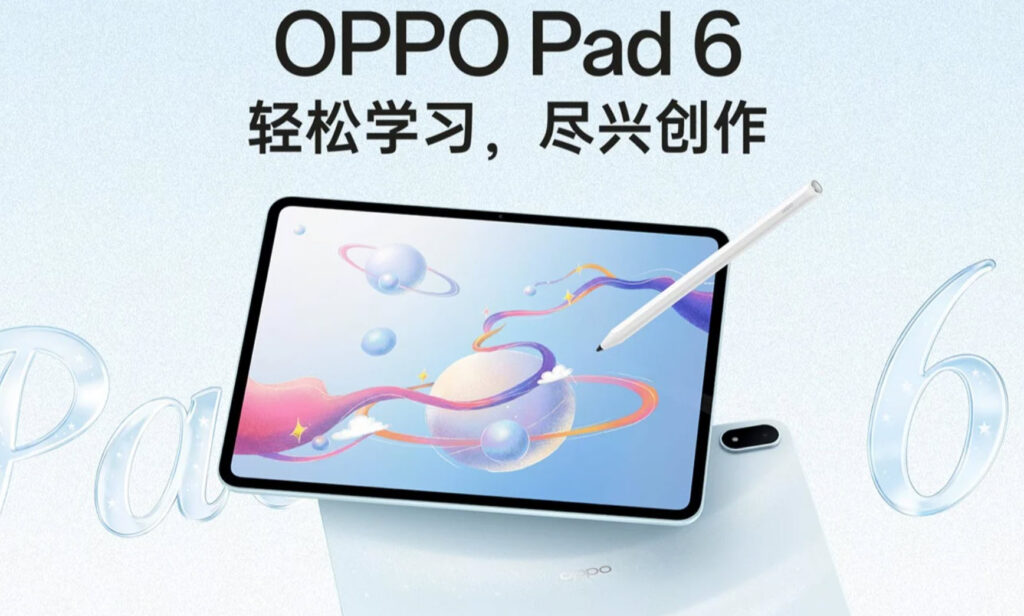
Table of Contents
A Leaner Build for a Crowded Market
OPPO has officially pulled back the curtain on the Pad 6 during its May 25th launch event in China. While the tablet market has largely plateaued into two distinct camps—ultra-portable mini slates and powerhouse laptop replacements—the Pad 6 attempts to straddle the line by prioritizing an aggressive industrial design and high-refresh visuals.
The first thing that stands out about the Pad 6 is its physical footprint. Measuring just 5.99mm in thickness and weighing in at 577 grams, it is one of the thinnest tablets currently in OPPO’s lineup. This slim profile is paired with a choice of three finishes: Starlight Blue, Galaxy Silver, and Deep Space Gray. The chassis is designed to be a portable productivity tool, avoiding the bulk often associated with high-capacity battery devices.
Visuals and the ‘Soft Light’ Approach
The centerpiece of the device is a 12.1-inch 3K LCD panel. While OLED remains the gold standard for contrast, OPPO has opted for a high-density LCD capable of a 144Hz refresh rate. This ensures fluid animations and a responsive feel during gaming or heavy multitasking.
More interesting is the implementation of OPPO’s “Soft Light” screen design. Rather than a simple matte overlay, this technology is engineered to diffuse ambient light and minimize glare and reflections. For users who primarily use their tablets for long-form reading or document review, this is a strategic addition that reduces eye strain compared to the mirror-like finish of traditional glass displays.
Performance: The Dimensity 9500s Engine
Under the hood, the Pad 6 is powered by the MediaTek Dimensity 9500s. This silicon is the same chip found in recent high-performance handsets like the POCO X8 Pro Max, suggesting that OPPO is leveraging a shared hardware ecosystem to keep costs down while maintaining high benchmarks. According to internal data, the chip is pushing scores over 3 million points on AnTuTu, placing it firmly in the upper echelon of Android tablet performance.
To sustain this power, OPPO has integrated a 10,420 mAh battery. While the capacity is substantial, the 67W fast charging is the more critical spec here, allowing users to top up the large cell without being tethered to a wall for half a day. This combination makes the Pad 6 a viable competitor for those who find the base-model iPads underpowered for heavy workloads.
Productivity and Ecosystem Integration
The software experience on the Pad 6 is heavily geared toward a “desktop-lite” experience. OPPO has doubled down on multitasking features, including floating windows and a PC-style file management system that moves away from the restrictive folder structures of early Android tablets. Stylus support is integrated natively, positioning the device as a digital notebook for students and professionals.
One of the more practical additions is the enhanced connectivity suite. The Pad 6 allows users to share a nearby OPPO phone’s 5G connection directly with the tablet, reducing the reliance on unstable public Wi-Fi or the battery drain of a traditional mobile hotspot.
When compared to the Pad 5, the Pad 6 represents an iterative refinement rather than a revolution. The jump in processing power and the refinement of the display are welcome, but the core value proposition remains the same: a high-end media consumption device that can handle light professional work. Whether it can break through the dominance of the Galaxy Tab and iPad series in the global market remains to be seen, but for the Chinese market, it offers a compelling mix of aesthetics and raw power.