The Ghost in the Machine: How Shutter Speed Defined the Visual Horror of the 1933 Nazi Book Burnings
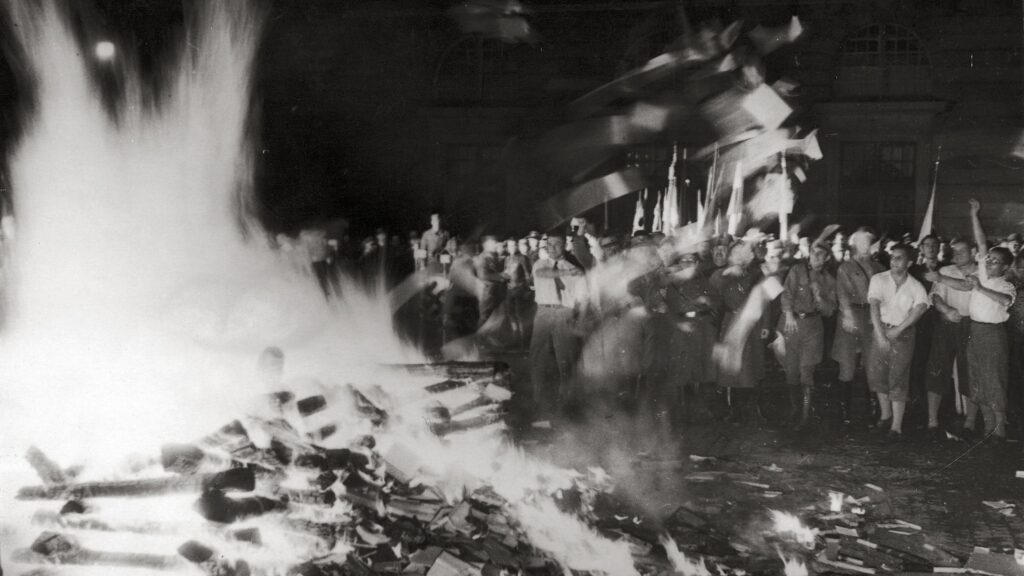
Table of Contents
The Technicality of Terror
In the lexicon of photojournalism, shutter speed is often discussed as a tool for precision—the ability to freeze a hummingbird’s wing or a sprinter’s stride. But when applied to the documentation of atrocity, the technical choice of exposure time shifts from a matter of clarity to a matter of psychological weight. Nowhere is this more evident than in the surviving imagery of the May 10, 1933, book burnings at the Opernplatz in Berlin.
The event, a coordinated assault on intellectual freedom led by Nazi student groups and spearheaded by Propaganda Minister Joseph Goebbels, saw the destruction of roughly 20,000 volumes. The works targeted were those of Jewish, liberal, and pacifist authors—anything deemed ‘un-German’ by the National Socialist regime. While the historical facts of the night are well-documented, the visual record offers two vastly different interpretations of the event based solely on the camera’s settings.
Freezing the Hatred
Many of the most widely circulated images from that night utilize a fast shutter speed. These photographs function as forensic evidence. They capture the exact moment a book leaves a hand, the precise tension in the muscles of the throwers, and the stark, unfiltered hatred etched into the faces of the crowd. There is a cold, clinical quality to these shots; they document the act of destruction with terrifying transparency.
From a technical standpoint, these images provide high information gain regarding the logistics of the event. We see the uniforms, the scale of the pyres, and the specific demographics of the participants. However, the ‘frozen’ nature of these images keeps the viewer at a distance, presenting the scene as a series of static, albeit horrific, snapshots.
The Haunting Power of Motion Blur
Contrast this with a specific, more ethereal set of images—often attributed to photojournalist George Pahl—where the shutter remained open longer. In these frames, the books are no longer distinct objects; they are ghostly, translucent streaks of white and grey descending into the flames. The humans in the frame become blurs of movement, stripped of their individuality and transformed into a collective, churning machine of destruction.
This is the result of motion blur, a phenomenon where the subject moves across the frame while the sensor (or in 1933, the film plane) is still capturing light. In a modern digital context, we often view motion blur as a mistake or a ‘shaky’ shot. In the context of the Opernplatz, however, it transforms the image from a literal record into a psychological landscape. The blurring of the books creates a sense of disappearance, mirroring the actual erasure of the ideas contained within those pages.
Intentionality vs. Limitation
A critical question for historians and photography enthusiasts is whether this effect was an intentional artistic choice or a byproduct of the era’s equipment. In 1933, photographers were dealing with the limitations of early 35mm cameras and varying film speeds. Achieving a perfect ‘freeze’ required significant light and precise manual settings.
Whether Pahl consciously chose a slower shutter speed to evoke the chaos of the night or was simply working with the available light, the result is an image that communicates the feeling of the event more accurately than a sharp photo ever could. The blur represents the instability, the frenzy, and the systemic erasure of culture. It suggests a world losing its grip on reason, rendered visually through the technical failure of a sharp focus.
This intersection of technology and trauma reminds us that the tools we use to capture history—from the Leica cameras of the 1930s to the AI-enhanced sensors of today—do not just record reality. They interpret it. The difference between a fast and slow shutter speed in the hands of a journalist can be the difference between documenting a crime and capturing a nightmare.


