The Value Trap: Why Framework’s Modular Ambitions Struggle Against the MacBook Neo
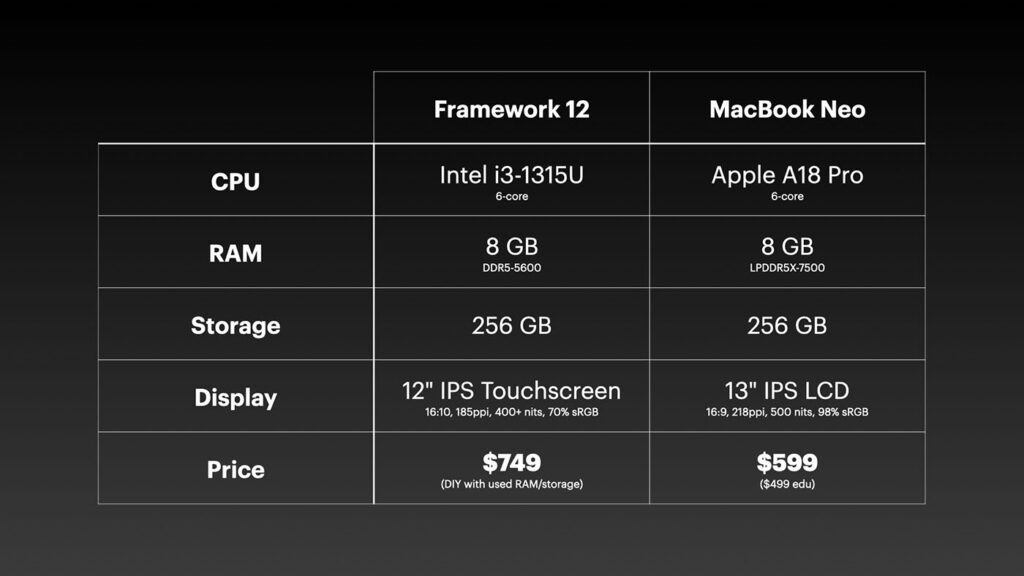
Table of Contents
The Clash of Philosophies
In the current laptop market, there is a widening chasm between the philosophy of ‘disposable excellence’ and ‘sustainable utility.’ On one side stands Apple with the MacBook Neo, a device that leverages massive economies of scale to deliver a polished, high-performance experience at a disruptive price point. On the other is Framework, a company betting that consumers will pay a premium for the right to repair and upgrade their own hardware.
When these two ideologies collide in a head-to-head value comparison, the results are sobering for the modular camp. While the Framework 12 is an admirable engineering feat, it currently struggles to justify its price tag when placed next to the Neo, particularly for students and budget-conscious users who prioritize raw performance over long-term maintainability.
Performance and Thermal Realities
The performance gap between the two machines is most evident in burst workloads and efficiency. Benchmarks using Geekbench 6 reveal a significant advantage for Apple’s low-end CPU cores over Intel’s current offerings in this form factor. The MacBook Neo isn’t just faster in a variety of real-world tasks; it is fundamentally quieter. Because the Neo utilizes a fanless design, it operates in total silence, whereas the Framework 12’s cooling system frequently ramps up, producing roughly 40-45 dBa of noise during demanding tasks.
However, the Framework 12 finds its niche in sustained performance. In heavy, long-term compute tasks—such as HPL (High Performance Linpack)—the Framework’s active cooling prevents the aggressive thermal throttling that eventually hits the fanless Neo. While the Neo must reduce its clock speed to manage heat, the Framework’s fans allow it to maintain a slightly higher performance floor, albeit at the cost of significant acoustic noise.
The Component Compromise
The most striking difference lies in the build quality and display. Apple’s vertical integration allows them to commission displays built exactly to their specifications, resulting in the Neo’s superior color accuracy and brightness. Framework, operating at a fraction of Apple’s scale, is forced to rely on off-the-shelf components. To accommodate the 360-degree hinge and touchscreen functionality of the Framework 12, the company had to make compromises on the panel quality.
Furthermore, the tablet mode—a key selling point for the Framework 12—feels more like a conceptual victory than a practical one. The reliance on older stylus technology makes the drawing experience inferior to a modern iPad or Surface Pro, and the ergonomics of a full laptop chassis in tablet mode remain cumbersome for daily use.
The Price of Repairability
The financial equation is where the Framework 12 faces its steepest challenge. A DIY edition of the Framework 12 starts at approximately $749 (assuming the use of budget-friendly 8GB RAM and 255GB SSD), while pre-built models climb to $799. In contrast, Apple has positioned the base model MacBook Neo at a disruptive $499.
For a 20% to 40% price premium, the user receives a machine that is generally slower, louder, and equipped with a lesser screen. The value proposition relies entirely on the modular ecosystem: the ability to swap DDR5 SODIMMs, NVMe SSDs, WiFi cards, and the four modular expansion ports on the chassis. For a power user or a Linux enthusiast, this flexibility is priceless. For a high school graduate or a casual user, it is a feature they may never actually utilize.
Market Positioning
Framework isn’t just fighting Apple; it is fighting the reality of the global supply chain. When a company can’t dictate the specs of the parts it buys, it must either raise the price or lower the specs. By choosing the latter for the screen and the former for the chassis, Framework has created a ‘utility laptop’ that is technically impressive but economically difficult to recommend over the Neo.
For those who truly value the ethics of repair and top-tier Linux support, Framework’s 13-inch lineup remains a compelling choice. But as a budget-friendly entry point for the masses, the Framework 12 finds itself in a difficult position: it is a great piece of hardware that is, unfortunately, a poor value proposition.