The Return of the ‘Magic Smoke’: Why F1’s New Power Units Are Killing Reliability
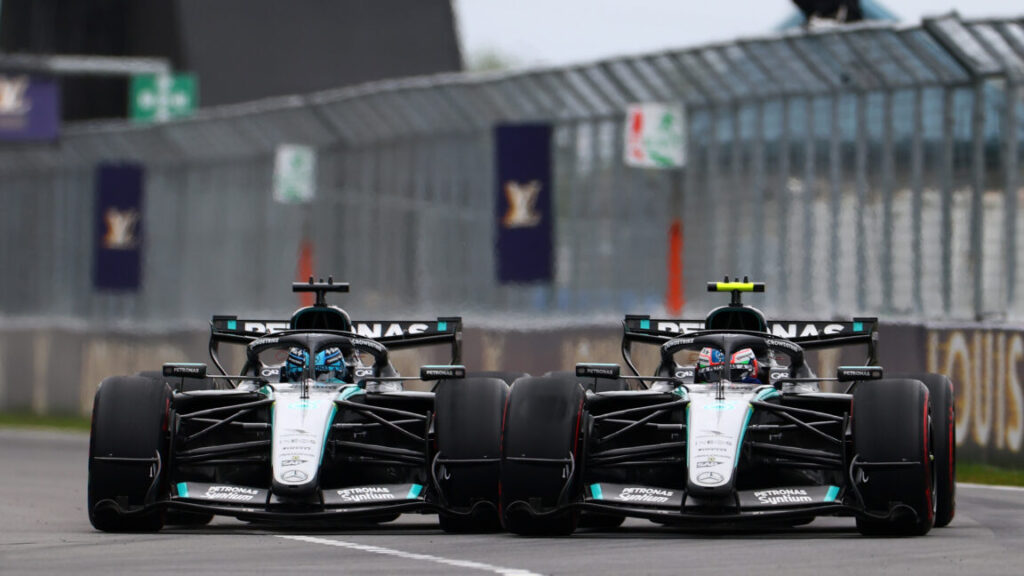
Table of Contents
A Sudden Shift in Stability
For nearly a decade, Formula 1 fans and engineers grew accustomed to a luxury that would have been unthinkable in the early 2000s: near-total mechanical reliability. Between 2017 and 2025, the hybrid era reached a peak of stability where a DNF (Did Not Finish) due to engine failure became a rarity. However, the 2026 season is proving that the era of the ‘bulletproof’ power unit was an outlier, not the new norm.
The fragility of the current machinery was on full display at the Canadian Grand Prix. While the race delivered the high-stakes duels typical of the Montreal circuit, the narrative was dominated by the collapse of George Russell’s Mercedes. Russell, who had been managing a precarious lead, suffered a catastrophic battery failure on lap 30, ending his day instantly. The frustration was visceral; Russell was seen discarding his neck surround onto the track in a gesture of pure exasperation.
This failure has significant championship implications. Kimi Antonelli, the 19-year-old Italian sensation, now holds a 43-point lead over Russell after four consecutive victories. In a sport where teammates use identical equipment, a gap of this magnitude—potentially spanning two full race wins—creates an immense psychological and tactical disadvantage for the veteran Russell.
The Technical Root: Beyond the V6
On the surface, the 2026 power units seem familiar: they retain the 1.6-liter V6 architecture. But beneath the casing, these are entirely new machines. The most critical departure is the removal of the MGU-H (Motor Generator Unit-Heat), the complex electronic turbocharger system that defined the previous generation.
The new regulations have shifted the energy paradigm. Engineers are now dealing with a fuel energy limit of 3,000 MJ/hour, replacing the previous 100 kg/hour flow restriction. Simultaneously, the MGU-K (Motor Generator Unit-Kinetic) and the lithium-ion battery packs have been completely redesigned to handle higher power outputs and energy loads. This transition mirrors the early, volatile days of the hybrid introduction in 2014, where reliability was a constant gamble.
Furthermore, the 2026 rules have introduced a systemic energy crisis. The current batteries lack the capacity to power the MGU-K for a full lap. To compensate, cars must divert power from the V6 internal combustion engine to the battery during the lap. This means that the fastest way to complete a circuit is no longer a matter of raw speed, but of energy management—essentially turning every lap into a high-speed chemistry experiment.
Historical Echoes of Mechanical Failure
The return of these failures brings F1 back to a state of unpredictability that defined the sport’s golden eras. The current stability was an anomaly; in the early 2000s, drivers faced a nearly 40% chance of mechanical failure in any given race. The history of the sport is littered with such tragedies: Felipe Massa’s engine failure three laps from victory in the 2008 Hungarian Grand Prix, or Mika Hakkinen’s final-lap hydraulic collapse at the 2001 Spanish Grand Prix that handed the win to Michael Schumacher.
Even the legendary Damon Hill suffered this cruelty in 1997, leading for the underfunded Arrows team in Hungary only to have a hydraulic leak strip away a deserved victory in the closing stages. While modern teams no longer strip cars down to the chassis every night—a practice that likely contributed to historical failures—the sheer complexity of the 2026 energy recovery systems has reintroduced the ‘magic smoke’ era. When the electrical systems fail, the car doesn’t just slow down; it ceases to function.
As the season progresses, the focus for teams like Mercedes and Ferrari will shift from pure aerodynamic gain to the grueling task of stabilizing these new power units. Until then, the championship remains volatile, proving that in Formula 1, the fastest car is useless if it cannot reach the checkered flag.