Google’s ‘Action-First’ Pivot at I/O 2026 threatens the traditional app economy
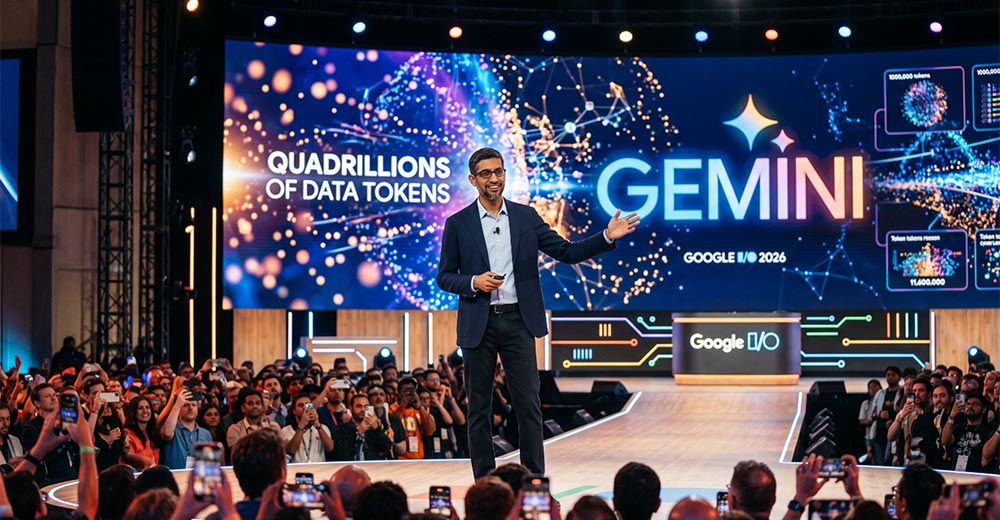
Table of Contents
The death of the ‘tap-and-scroll’ interface
For nearly two decades, the mobile experience has been defined by a grid of colorful icons. We open an app, navigate a menu, and perform a specific task. But following the presentations at Google I/O 2026, that paradigm is starting to look like a relic. Google is no longer just building an assistant that sits on top of the OS; it is building an OS that renders the standalone app interface optional.
The centerpiece of the announcement is a deeper integration of Gemini into the core Android kernel, effectively turning the operating system into a massive, multimodal agent. Instead of directing users to open a travel app to book a flight or a fitness app to log a workout, Gemini now executes these actions through ‘headless’ API calls. The user expresses an intent, and Google’s AI handles the logistics in the background, pulling data from various services without the user ever seeing a loading screen or a home page.
From App Stores to Agent Protocols
This shift signals a fundamental change in how software is distributed and monetized. If the AI agent becomes the primary interface, the concept of ‘user engagement’—the holy grail for app developers—changes overnight. When a user no longer spends time scrolling through a UI to find a feature, the opportunities for ad impressions and in-app purchases evaporate.
Industry analysts are calling this the ‘Agentic Layer.’ By leveraging a new set of open standards for AI-to-app communication, Google is essentially proposing a world where apps function more like plugins or background services than destination experiences. This puts immense pressure on developers to optimize for machine readability rather than visual appeal. If your app isn’t easily ‘crawlable’ by Gemini, it risks becoming invisible to the user.
The battle for the ‘Intent’
This strategy isn’t without risk. By positioning Gemini as the sole gateway to digital services, Google is doubling down on a closed-loop system that could trigger significant regulatory scrutiny. The Department of Justice has already spent years probing Google’s search dominance; an attempt to monopolize the ‘intent’ layer of the mobile experience could be seen as another move to stifle competition.
Furthermore, there is the question of trust. Entrusting an AI agent to handle financial transactions, health data, and personal scheduling requires a level of reliability that current LLMs still struggle to maintain. While the 2026 demos showed seamless execution, the ‘hallucination’ problem remains a critical bottleneck for high-stakes tasks.
A new reality for developers
For startups and independent developers, the I/O 2026 updates are a wake-up call. The value proposition is shifting from User Experience (UX) to API Efficiency. The winners of the next cycle won’t be the companies with the flashiest interfaces, but those whose data structures are the most accessible to AI agents.
As Google pivots toward this action-first model, the Android home screen may eventually become a ghost town of icons, replaced by a single, fluid conversational interface that knows what you want before you even tap the screen.


