Lenovo Pushes OLED Boundaries at CES 2026 With Duo of Rollable Concept Laptops
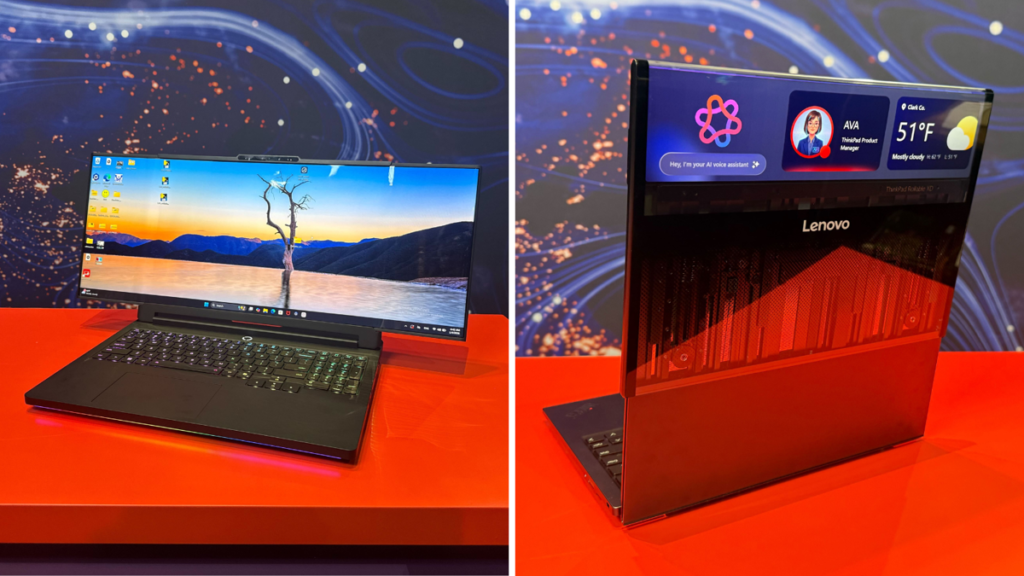
Table of Contents
Moving Beyond the Fold
While the industry has spent the last few years trying to perfect the foldable screen, Lenovo is betting that the future of portable productivity isn’t a crease, but a roll. At CES 2026, the company unveiled two new prototypes—the ThinkPad Rollable XD Concept and the Legion Pro Rollable Concept—that move past the simple ‘fold’ to offer displays that dynamically expand their surface area on demand.
These devices are an evolution of the ThinkBook Plus Gen 6 Rollable AI, which transitioned from a conceptual curiosity to a market reality. The new prototypes suggest Lenovo is no longer just testing if the technology works, but is now experimenting with how different form factors—specifically business and gaming—can leverage expandable glass.
ThinkPad Rollable XD: Vertical Expansion and Transparency
The ThinkPad Rollable XD is designed for the mobile professional who needs a 16-inch experience in a 13-inch chassis. Through a motorized rolling mechanism housed in the lid, the OLED panel can grow from 13.3 inches to nearly 16 inches in height, providing a 50 percent increase in vertical screen real estate. This allows for a more natural document view or deeper code visibility without the bulk of a traditional large-format laptop.
What distinguishes the XD from previous iterations is its ‘world-facing’ integration. The OLED display wraps 180 degrees over the top edge of the lid, creating a secondary screen on the back. To protect this precarious curve, Lenovo partnered with Corning to develop a specialized transparent glass cover. This design choice serves a dual purpose: it protects the panel while acting as a window into the device’s internals, exposing the fiber cables and motors that drive the rolling action.
Interaction with the screen is handled via physical buttons or a touch-sensitive edge along the lid, allowing users to slide the display to their preferred height. While it lacks the voice and gesture controls seen in earlier prototypes, the tactile response of the current interface feels more aligned with a production-ready device.
Legion Pro Rollable: The ‘Arena Mode’ Powerhouse
If the ThinkPad is about productivity, the Legion Pro Rollable is about sheer immersion. Eschewing the vertical growth of its sibling, the Legion Pro expands horizontally. In its standard ‘Focus Mode,’ it operates as a 16-inch laptop with a high-refresh 240Hz OLED panel. However, it can scale up to 21.5 inches in ‘Tactical Mode,’ and eventually expand to a full two feet in what Lenovo calls ‘Arena Mode.’
The result is essentially an integrated ultra-wide monitor that emerges from the chassis, potentially rendering dual-screen solutions like the Asus ROG Zephyrus Duo obsolete by offering a single, continuous canvas. Beneath the hood, Lenovo isn’t compromising on power. The prototype is slated to mirror the specs of the Legion Pro 7i, featuring high-end Intel Core processors and the Nvidia GeForce RTX 5090 GPU.
The ambition of the hardware, however, brings significant engineering trade-offs. During demonstrations, the device emitted substantial heat even while idling, a byproduct of cramming a 5090-class GPU into a chassis that must also house rolling motors. There is also the matter of long-term durability; Lenovo rates the mechanism for 25,000 roll cycles, though superficial marks and slight creasing were visible on the panel during the unfurling process.
From Concept to Consumer
The transition from the original ThinkBook rollable concept to a retail product took approximately two years. Given the polish of these two new prototypes, a commercial version of the Legion or ThinkPad rollables is a plausible mid-term goal. However, the price point will likely be the primary barrier to entry. With the previous rollable model retailing at $3,499.99, these high-spec concepts will almost certainly target the ultra-premium enthusiast and corporate tiers.


