Sennheiser Momentum 5 Wireless Review: Audiophile Sound Finally Meets Competitive Noise Canceling
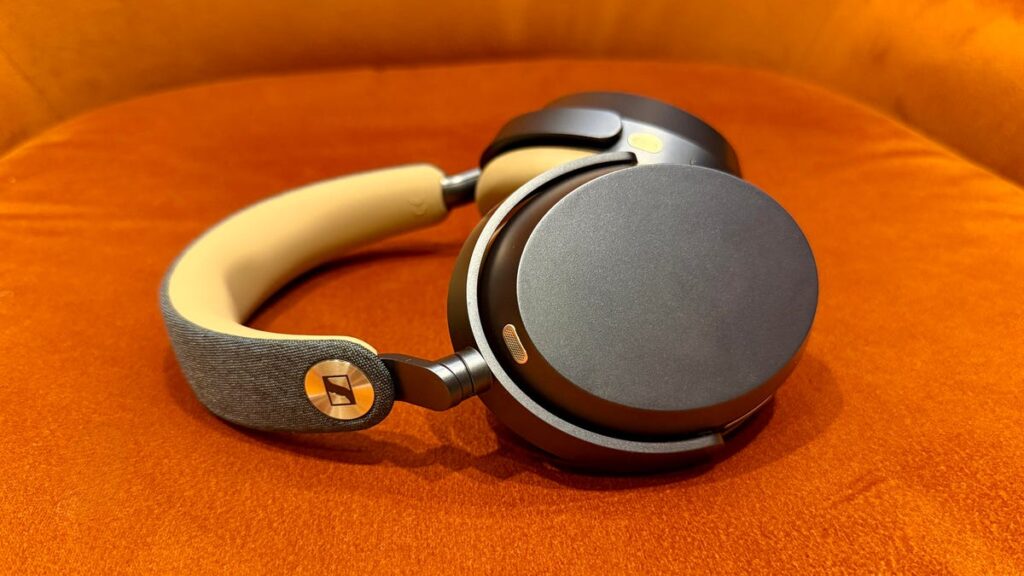
Table of Contents
The Tension Between Fidelity and Silence
For years, Sennheiser has occupied a specific, somewhat precarious position in the premium wireless market. Their Momentum line has always offered a sonic profile that makes Sony and Bose sound clinical or overly processed, but that auditory edge often came at the cost of effective noise cancellation. The Momentum 4 Wireless was a sonic triumph but an ANC disappointment, leaving users to choose between music quality and the ability to block out a jet engine.
The Momentum 5 Wireless arrives as a corrective measure. While it retains the same chassis as its predecessor—a move that may frustrate those hoping for a visual overhaul—the internals have been significantly reworked. Sennheiser is no longer just aiming for the audiophile; they are finally taking a serious shot at the ANC crown.
Hardware: Iteration Over Innovation
Physically, the Momentum 5 is a mirror image of the Momentum 4. At 290 grams, it remains slightly heavier than the Sony WH-1000XM6, but the weight distribution is well-managed. The cushioned earpads are comfortable for long sessions, and the build quality remains sturdy, despite the heavy use of plastics. The only significant design victory here is the carrying case: it’s slimmer, more portable, and features a thoughtful integrated handle.
Under the hood, the most critical change is the microphone array. Sennheiser has doubled the count, moving from four microphones to eight. This isn’t just for better voice calls—though those remain a slight weak point—it’s the engine driving the improved Active Noise Cancellation (ANC). In real-world testing, the Momentum 5 has moved from ‘middling’ to ‘good.’ While it still hasn’t quite reached the eerie, total silence provided by the Bose QuietComfort Ultra or the AirPods Max 2, the gap has narrowed significantly. High-frequency shrills still occasionally pierce through, but the low-end drone of commuting is handled with far more authority than before.
Sonic Performance and New Features
Where the Momentum 5 continues to dominate is in its tuning. The sound remains detailed and transparent, with a natural mid-range that prevents vocals from sounding recessed or artificial. The bass is well-defined without bleeding into the mids, maintaining the ‘Sennheiser house sound’ that enthusiasts crave.
The addition of spatial audio with head tracking brings the Momentum 5 into the modern era, allowing for a more immersive listening experience that mimics a multi-speaker setup. However, the most practical upgrade is the user-replaceable battery. In an era of planned obsolescence, providing a way to swap the power cell is a rare and welcome move for sustainability.
Power management has also seen a subtle shift. The headphones now require a manual press of the power button to wake up. While this adds a step, it solves a common grievance with the Momentum 4, which would often auto-pair with a phone simply by being removed from the case, regardless of whether the user intended to use them.
The Market Positioning
At $400, the Momentum 5 is $50 more expensive than the launch price of the Momentum 4. This price hike is justified by the improved ANC and the inclusion of spatial audio, but it puts the device in direct competition with the Sony WH-1000XM6. For those who prioritize the absolute strongest noise isolation, Sony still holds the edge. But for users who believe that the primary purpose of headphones is to actually *hear* the nuances of the music, the Momentum 5 is the superior instrument.
For those seeking even more precision, Sennheiser offers the HDB 630 ($500), which pairs with a BTD 700 USB-C dongle for lossless 24-bit/96kHz streaming via aptX Adaptive. While the HDB 630 is the purist’s choice, the Momentum 5 strikes the ideal balance for the modern commuter who refuses to sacrifice audio fidelity for silence.