Samsung Floods Indian Market With 72 New TV Models, Betting Big on Micro LED and Neo QLED
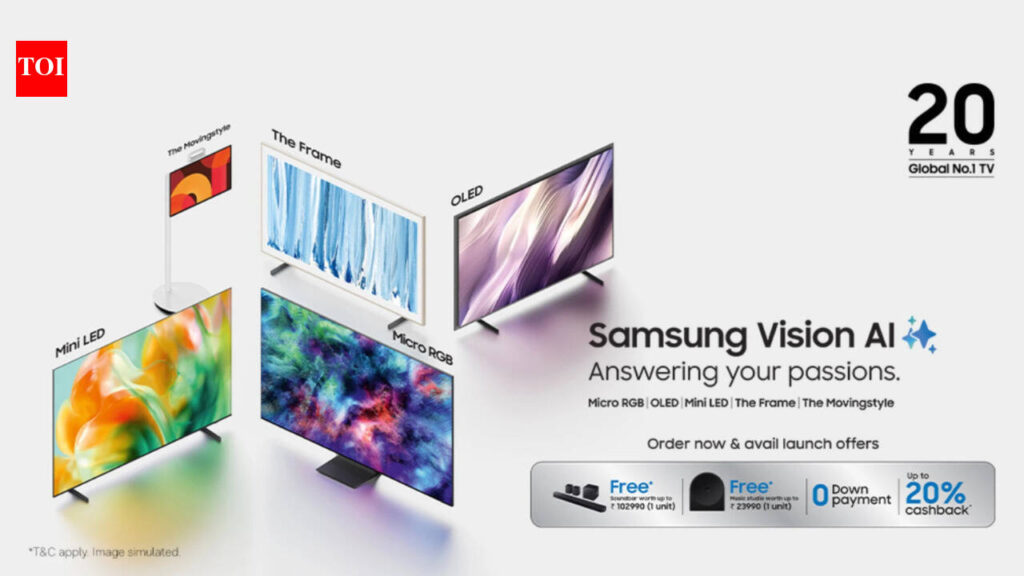
Table of Contents
A Volume Play for the Subcontinent
Samsung has unveiled its 2026 television portfolio for the Indian market, a staggering deployment of 72 different models designed to capture every possible price bracket and room size. While the sheer volume of SKUs suggests a strategy of market saturation, the real story lies in the technology mix. For the first time, Samsung is pushing Micro LED more aggressively in India, attempting to move the technology from an ultra-luxury curiosity into a viable, albeit expensive, alternative for high-end home cinemas.
The 2026 lineup is built on four primary pillars: Micro LED, OLED, Neo QLED, and Mini LED. By diversifying across these four panel types, Samsung is hedging its bets against a shifting consumer preference where some users prioritize the absolute blacks of OLED, while others are opting for the searing peak brightness and longevity of Neo QLED’s Quantum Mini LEDs.
The Micro LED Gambit
Micro LED has long been the ‘holy grail’ of display tech—offering the self-emissive precision of OLED without the risk of organic degradation or burn-in. Until now, these sets have been largely custom-built and prohibitively priced. Samsung’s decision to integrate Micro LED more deeply into the 2026 Indian rollout indicates a push toward modularity. These displays are designed to be scalable, allowing users to essentially ‘build’ their screen size to fit the wall, a feature specifically targeted at the luxury villa market in cities like Mumbai and Delhi.
Scaling Neo QLED and Mini LED
While Micro LED captures the headlines, the bulk of the 72-model rollout focuses on Neo QLED and Mini LED. These sets utilize a dense grid of tiny LEDs to provide tighter backlight control, significantly reducing the ‘blooming’ effect often seen in traditional LED TVs. In the context of India’s bright living rooms, the high nits of the Neo QLED series provide a distinct advantage over OLED, which can struggle with glare in sun-drenched spaces.
Industry analysts suggest that by flooding the market with so many variations, Samsung is attempting to stifle the growth of aggressive Chinese competitors who have dominated the budget-to-mid-range segments. By offering a Mini LED option at nearly every single price point, Samsung is effectively closing the gap between the ‘entry-level’ and ‘premium’ experience.
Intelligence Beyond the Panel
Hardware aside, the 2026 series is heavily integrated with the latest iteration of Samsung’s AI Upscaling engine. The goal is to bring older 1080p or 720p content—which still makes up a significant portion of broadcast media in India—up to a perceived 4K or 8K quality. This processing power is crucial for the 8K models in the lineup, where native content remains scarce.
The integration of the SmartThings ecosystem also remains a focal point. The TVs are positioned not just as screens, but as central hubs for the home, allowing users to control IoT devices and monitor security cameras directly from the Tizen OS interface. This push for a ‘connected home’ is a direct response to the increasing adoption of smart home hardware across urban Indian households.
The Competitive Landscape
This rollout puts immense pressure on LG and Sony, who typically maintain a more curated, lower-volume approach to their Indian portfolios. By offering 72 models, Samsung ensures that no matter the specific budget or room dimension, there is a ‘Samsung-branded’ solution available. Whether it’s a compact 43-inch Mini LED for a bedroom or a massive 110-inch Micro LED for a boardroom, the company is leaving no stone unturned in its quest for domestic dominance.


