POCO Pad C1 Arrives: Xiaomi’s New Budget Tablet Bets on a 2K Display and 4G Connectivity
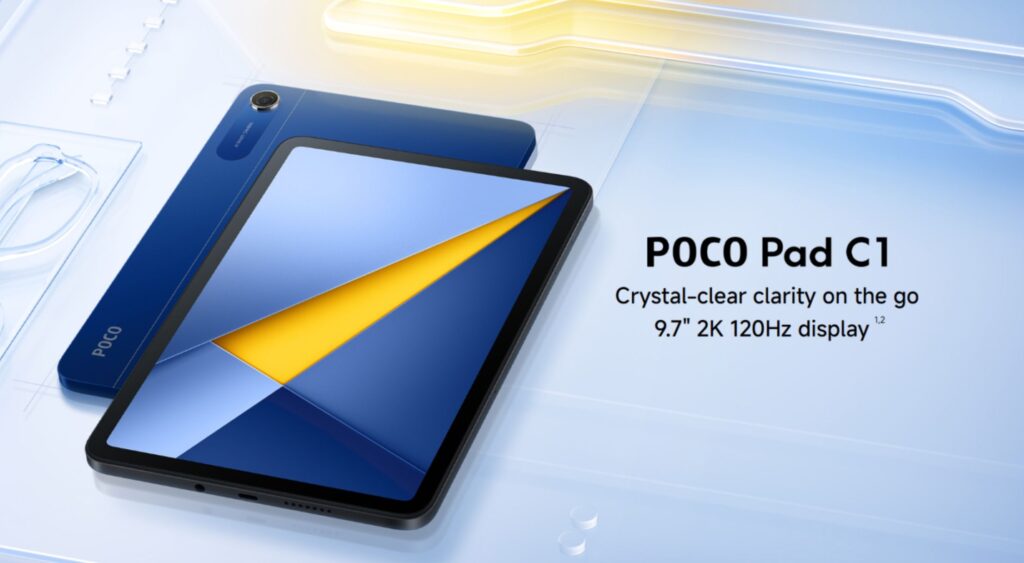
Table of Contents
A Strategic Pivot Toward the Entry-Level
Xiaomi has officially expanded its tablet portfolio with the global debut of the POCO Pad C1. While the enthusiast market has largely shifted toward high-performance OLED panels and flagship silicon, the C1 is a calculated move to capture the ‘essential’ user—those who need a reliable device for media consumption, student work, and basic multitasking without the $500 price tag.
The device enters a crowded budget segment, but it attempts to distinguish itself through a surprising commitment to screen quality. At the heart of the POCO Pad C1 is a 9.7-inch IPS display that pushes a 2K resolution. More importantly, Xiaomi has equipped the panel with a 120Hz refresh rate, a feature typically reserved for mid-range or premium slates. This ensures that UI navigation within HyperOS feels fluid, avoiding the stutter often associated with low-cost Android hardware.
To handle outdoor visibility, the screen hits a peak brightness of 500 nits, extending to 600 nits in specific outdoor conditions. The inclusion of TUV Rheinland certification for low blue light and flicker reduction suggests that Xiaomi is positioning this as a device for long-term reading and PDF review, targeting the education sector specifically.
The Hardware Trade-off: Snapdragon 6s 4G
To keep the cost below the projected $300 mark, Xiaomi has made some pragmatic compromises in the engine room. The POCO Pad C1 is powered by the Qualcomm Snapdragon 6s 4G Gen 2. As the name implies, this is a 4G-capable chipset, meaning users won’t be seeing 5G speeds here. However, for the target demographic—streaming Netflix, browsing the web, and using Google Workspace—the 6GB of RAM and 128GB of internal storage provide a sufficient baseline.
Storage flexibility is handled via a microSD slot supporting up to 2TB of expansion, a critical feature for those using the tablet as a portable media library. The software experience is driven by HyperOS 3.0, which integrates several of Xiaomi’s latest AI initiatives. Notably, the C1 supports Circle to Search and Google’s Gemini, bringing generative AI capabilities to a price point where such features are usually stripped away.
Battery Life and Physicality
The chassis is a slim metal build, measuring just 7.4mm in thickness and weighing in at 406 grams. This makes it highly portable, avoiding the bulkiness of larger 11-inch or 12-inch tablets. Powering the device is a 7,600 mAh battery. While this is smaller than the massive cells found in the POCO Pad’s larger siblings, it is scaled to the 9.7-inch screen. Xiaomi claims up to 15 hours of continuous video playback, though real-world usage with 120Hz enabled will likely be lower.
Charging is handled via 18W wired charging. By modern standards, this is slow—likely taking several hours to reach a full charge—but it aligns with the device’s identity as a low-intensity consumption tool rather than a productivity powerhouse.
Connectivity and Final Verdict
In an era where the 3.5mm headphone jack is disappearing from almost every mobile device, POCO has retained it on the C1. Combined with dual speakers, the device is clearly aimed at the student and casual media viewer who doesn’t want to rely solely on Bluetooth peripherals.
The camera setup is utilitarian: an 8MP rear sensor and a 5MP front camera. Neither is designed for high-quality photography, but they are sufficient for document scanning and the occasional video call.
By pricing the POCO Pad C1 under $300, Xiaomi is creating a bridge between the low-end 7-inch tablets and the premium Pro models. It doesn’t try to replace a laptop, but it offers a high-quality visual experience that makes it a compelling alternative to entry-level tablets from Samsung or Lenovo.