Atmospheric Anomaly or Orbital Debris? Mysterious Fireball Streaks Across Philippine Skies During Volcanic Activity
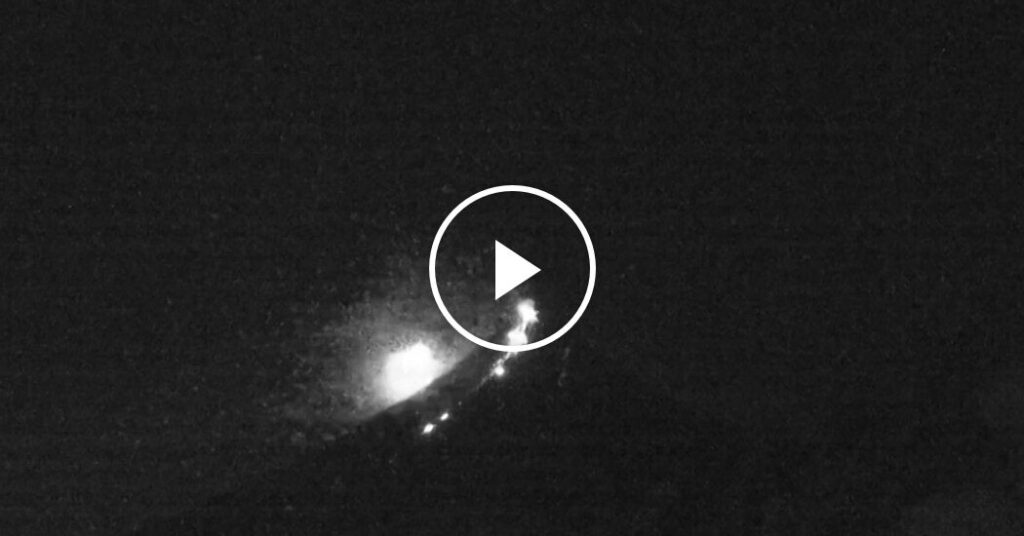
Table of Contents
A Rare Convergence of Geological and Atmospheric Events
Footage circulating from the Philippines has captured a striking visual coincidence: a brilliant fireball streaking through the atmosphere directly above an actively erupting volcano. The video, which has quickly gained traction across social media and digital news platforms, shows a luminous object descending at a steep angle, cutting through the haze and volcanic ash plumes that typically characterize an eruption event.
While the visual is cinematic, it raises a technical question for astronomers and space debris trackers: was this a naturally occurring bolide, or the reentry of man-made orbital hardware? The timing—occurring simultaneously with high-altitude volcanic emissions—adds a layer of complexity to the observation, as ash particles can sometimes affect the visibility and perceived trajectory of atmospheric entries.
The Physics of Atmospheric Reentry
When an object enters Earth’s atmosphere at speeds exceeding 11 kilometers per second, the compression of air in front of the object creates an intense shock wave. This process, known as adiabatic compression, generates temperatures high enough to ionize the surrounding gas, creating the glowing plasma trail seen in the footage. If the object is a meteor, it is typically composed of silicate or iron; if it is space debris, it is likely a fragment of a defunct satellite or a spent rocket stage.
Distinguishing between the two requires precise telemetry. Meteorites generally move faster and exhibit a more sudden “burst” or fragmentation. In contrast, orbital debris often breaks apart more gradually, leaving a fragmented trail of glowing pieces known as a “debris train.” In this specific instance, the fireball’s brightness and persistence suggest a significant mass, though without radar confirmation from agencies like USSPACECOM or the Philippine Space Agency (PhilSA), a definitive origin remains elusive.
The Impact of Volcanic Aerosols on Observation
The presence of an erupting volcano in the frame is more than just a dramatic backdrop. Volcanic eruptions eject massive quantities of sulfur dioxide and ash into the stratosphere. These aerosols can act as a refractive medium, potentially altering the perceived color of the fireball or creating a “halo” effect as the light interacts with the particulate matter in the air.
For researchers in atmospheric monitoring, such events provide a rare opportunity to study how high-energy light sources interact with dense volcanic plumes. The contrast between the incandescent glow of the fireball and the diffuse, grey ash cloud provides a natural laboratory for analyzing the optical density of the eruption’s column.
The Growing Problem of Orbital Crowding
This event occurs against a backdrop of increasing orbital congestion. With the rise of mega-constellations like SpaceX’s Starlink and the proliferation of small-satellite launches, the probability of “reentry events” is climbing. Most of these objects incinerate completely upon reentry, but the frequency of these sightings is increasing as the Low Earth Orbit (LEO) environment becomes more crowded.
Unlike controlled reentries, where agencies can predict the impact zone, uncontrolled reentries—like the one potentially captured in this video—are erratic. While the risk of ground impact is statistically low, the visual evidence of these events serves as a reminder of the “Kessler Syndrome”—the theory that a critical mass of debris could trigger a cascade of collisions, making certain orbits unusable.
Current Status of Verification
At this time, official confirmation from the Philippine Institute of Volcanology and Seismology (PHIVOLCS) regarding the specific volcanic activity accompanying the video has not been synchronized with a formal space-track event. Analysis of the footage continues as experts look for matching signatures in the Global Fireball Observatory database to determine if the object was a stony meteoroid or a piece of aluminum-titanium alloy from a discarded satellite.


