Lenovo pushes the limits of form factor at CES 2026 with dual rollable OLED concepts
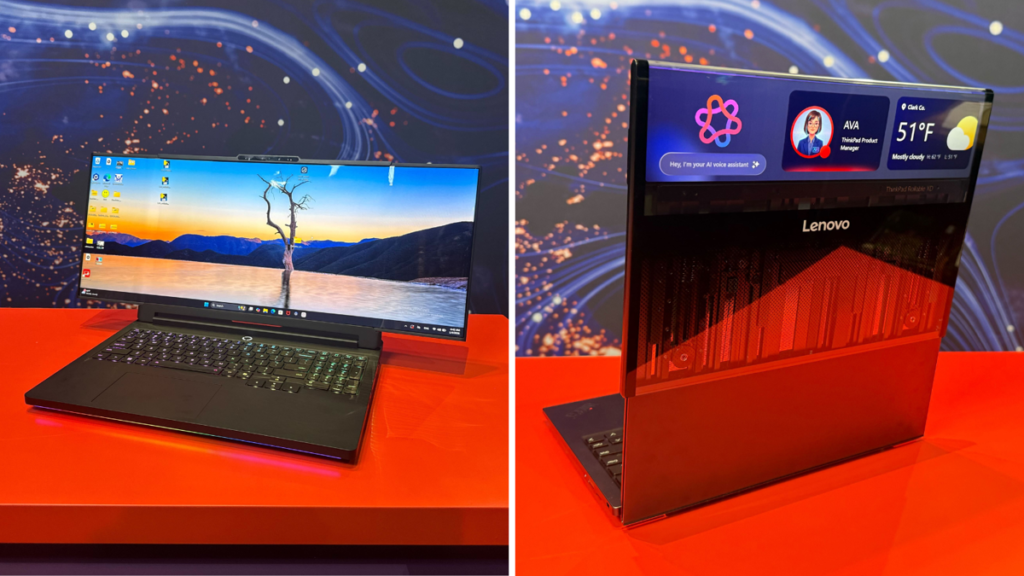
Table of Contents
The era of the static screen is facing a challenge
Lenovo has spent the last few years treating the laptop chassis as a playground for mechanical experimentation. Following the commercial release of the ThinkBook Plus Gen 6 Rollable AI, the company returned to CES 2026 with two new prototypes that suggest the ‘rollable’ form factor is not a one-off gimmick, but a serious design trajectory. The ThinkPad Rollable XD Concept and the Legion Pro Rollable Concept represent two very different philosophies of how we might interact with screen real estate in the coming years.
While both devices are technically concepts, they feel remarkably close to production-ready hardware. Lenovo’s engineering team is leveraging the inherent flexibility of OLED panels, which can be manufactured thin enough to be wound around a motorized spool without losing structural integrity. During private demonstrations, the devices operated with a smoothness that suggests the primary hurdles remaining are not mechanical, but related to long-term durability and cost-optimization.
ThinkPad Rollable XD: More than just extra vertical space
The ThinkPad Rollable XD targets the productivity sector, addressing the perpetual struggle between portability and screen size. The device features a display that expands vertically, growing from a standard 13.3-inch footprint to nearly 16 inches. This 50 percent increase in surface area happens in seconds, effectively transforming a compact ultraportable into a workstation-class display without the need for a folding crease.
However, the most striking engineering feat is the “world-facing” display. The OLED panel doesn’t stop at the top edge of the lid; it wraps 180 degrees around to the back. To protect this precarious curve, Lenovo partnered with Corning to develop a specialized transparent glass cover. This design choice serves a dual purpose: it allows the user to display information to others and, perhaps more importantly for tech enthusiasts, exposes the internal fiber cables and motors that drive the rolling mechanism. This transparency turns the laptop’s internals into a visual centerpiece, highlighting the mechanical complexity of the device.
Control for the XD is intuitive, utilizing a combination of physical buttons and a touch-sensitive edge on the lid. While it lacks the voice and gesture controls found in previous iterations, the fluidity of the motor suggests a refined user experience that could easily translate to a retail product.
Legion Pro Rollable: A ‘Tactical’ approach to gaming
If the ThinkPad is about subtle productivity, the Legion Pro Rollable is an unapologetic exercise in excess. Designed for the competitive gaming market, this concept tackles the “laptop vs. monitor” dilemma by integrating an expanding screen that grows horizontally. The device operates in three distinct modes:
- Focus Mode: A standard 16-inch gaming laptop configuration.
- Tactical Mode: The screen expands to 21.5 inches, providing a wider field of view for immersive titles.
- Arena Mode: The display unfurls to a full two feet, essentially acting as a built-in external monitor.
Under the hood, the Legion Pro Rollable isn’t compromising on power. It is configured similarly to the Legion Pro 7i, packing an Intel Core processor and a powerhouse Nvidia GeForce RTX 5090 GPU. However, this level of performance comes with a cost. During demos, the device emitted significant heat, with fans working overtime even without a demanding game running. The chassis is also considerably bulkier to accommodate the complex rolling machinery and the necessary cooling systems.
From a build quality perspective, the Legion is nearly there, though not perfect. Some superficial marking was visible on the screen during unfurling, and a subtle crease remains where the OLED retreats into its housing. Lenovo claims the mechanism is rated for 25,000 roll cycles—a number that suggests they are thinking about the product’s lifespan in years, not just as a showpiece.
The cost of innovation
The transition from concept to consumer is often a matter of price. The original ThinkBook Plus Gen 6 entered the market with a staggering $3,499.99 price tag, positioning it as a luxury tool for early adopters rather than a mainstream replacement for the MacBook or XPS. Given the increased complexity of the Legion Pro’s horizontal expansion and the XD’s wrap-around glass, these next-generation rollables will likely command an even higher premium.
Whether these devices eventually hit shelves or remain as “north star” concepts, they signal a shift in how Lenovo views the PC. By moving the rolling mechanism into the lid—rather than the base—and experimenting with multi-directional expansion, they are proving that the laptop doesn’t have to be a static clamshell.


