Lenovo pushes OLED boundaries at CES 2026 with two new rollable laptop concepts
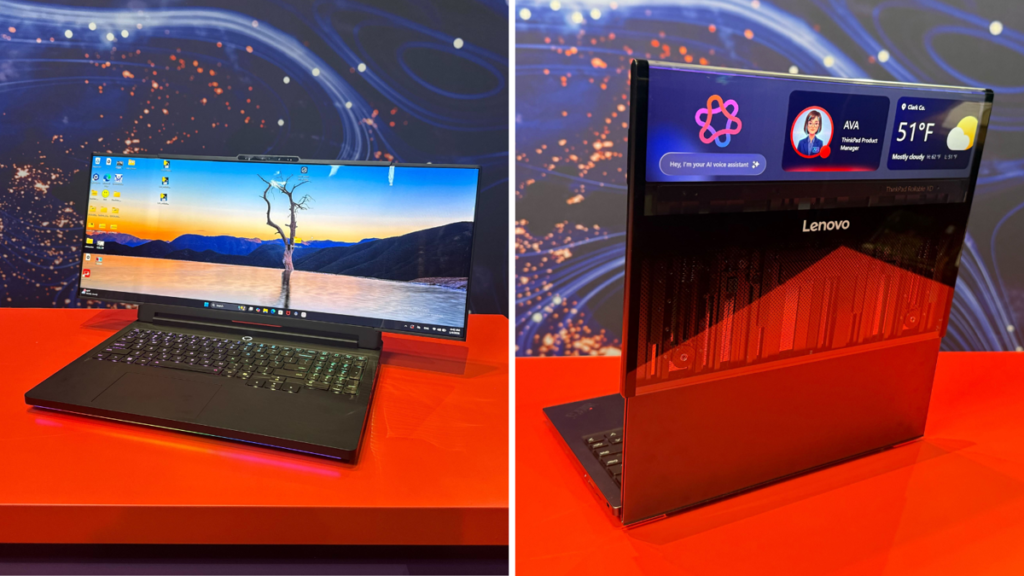
Table of Contents
Moving beyond the fold
While the industry has spent the last few years attempting to perfect the fold, Lenovo is betting that the future of flexible computing is actually rollable. At CES 2026, the hardware giant unveiled two distinct prototypes—the ThinkPad Rollable XD and the Legion Pro Rollable—that move past the simple hinge in favor of motorized OLED panels that expand and contract on demand.
These devices arrive shortly after Lenovo transitioned its first rollable project, the ThinkBook Plus Gen 6, from a concept to a commercial product. The new prototypes suggest Lenovo is no longer just experimenting with the physics of flexible glass, but is now tailoring the technology to specific user personas: the mobile executive and the hardcore gamer.
ThinkPad Rollable XD: Verticality and transparency
The ThinkPad Rollable XD is a study in productivity scaling. In its base state, it functions as a standard 13.3-inch laptop, but via a motorized mechanism, the screen expands vertically to nearly 16 inches. This 50 percent increase in screen real estate happens in seconds, effectively transforming a portable ultra-portable into a workstation-class display without increasing the device’s permanent footprint.
The most striking engineering feat here is the 180-degree wrap. The OLED panel curves over the top edge of the lid, creating a secondary, world-facing display on the back of the device. To achieve this, Lenovo partnered with Corning to develop a specialized transparent glass cover. This design choice isn’t just for utility; it allows a glimpse into the internal fiber cables and motors that drive the rolling mechanism, turning the hardware itself into a visual feature.
Interaction with the XD is handled through a combination of physical buttons and touch-sensitive edges on the lid. Interestingly, the voice and gesture controls found in previous iterations have been stripped back, suggesting a pivot toward more reliable, tactile inputs for a business-centric device.
Legion Pro Rollable: The ‘Arena’ of gaming
If the ThinkPad is about subtle expansion, the Legion Pro Rollable is an aggressive reimagining of the gaming rig. Rather than expanding vertically, this device pushes outward from both sides. It features a high-refresh 240Hz OLED panel that transitions through three distinct modes: ‘Focus Mode’ at 16 inches, ‘Tactical Mode’ at 21.5 inches, and a massive ‘Arena Mode’ that extends the screen to a full two feet.
For gamers, this eliminates the need for a secondary portable monitor or the awkward ergonomics of dual-screen laptops like the Asus ROG Zephyrus Duo. The display simply manifests from the chassis, providing an immersive wide-angle view that is rare in a laptop form factor.
Under the hood, Lenovo isn’t cutting corners. The prototype is spec’d similarly to the Legion Pro 7i, featuring Intel Core processors and an Nvidia GeForce RTX 5090 GPU. However, the sheer power of these components creates a significant thermal challenge. During demonstrations, the device emitted substantial heat even while idling, a reminder that packing a flagship GPU into a chassis with moving screens requires extreme cooling efficiency.
Engineering hurdles and the cost of innovation
Despite the polish, these are still prototypes. Subtle creasing where the OLED panel enters its housing and minor surface scuffs on the Legion model indicate that durability is still the primary hurdle. Lenovo claims the mechanism is rated for 25,000 roll cycles, but real-world longevity in dusty or humid environments remains an open question.
The financial barrier will also be steep. Given that the ThinkBook Plus Gen 6 debuted at approximately $3,499, these more complex rollables will likely target an even higher price bracket, positioning them as luxury halo products rather than mass-market replacements for the MacBook or standard XPS lines.


