The Art of the Micropatch: How 0patch is Resurrecting Word’s Abandoned Equation Editor
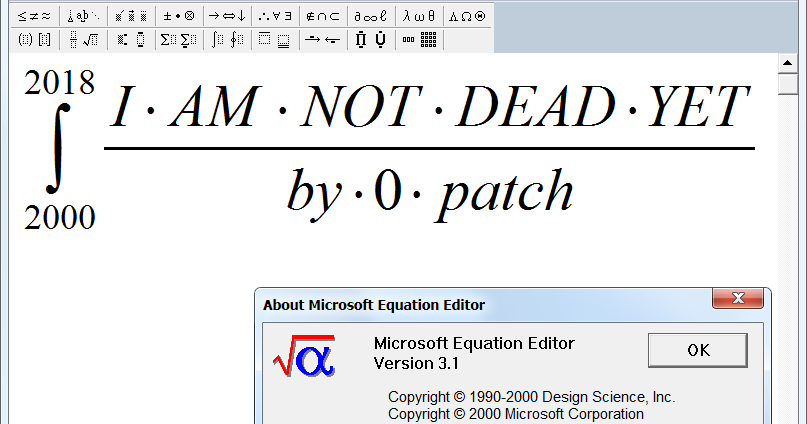
Table of Contents
A Digital Relic in the Crosshairs
For nearly two decades, the Microsoft Equation Editor was a staple for academics, engineers, and students. It was a quiet, functional utility that lived inside Word documents, allowing users to render complex mathematical notation. But in the eyes of modern security researchers, the tool was less of a utility and more of a liability—a 17-year-old pile of insecure code that had finally become too dangerous for Microsoft to support.
The downfall began when security firms, most notably Embedi, started peeling back the veil of obscurity surrounding the editor. Once the attack surface was exposed, the floodgates opened. A string of vulnerabilities followed in quick succession, including CVE-2018-0802 and CVE-2018-0798, turning a once-trusted tool into a primary vector for exploits. Microsoft’s response was decisive: disable the editor.
For most, this was a necessary security measure. But for users with decades of legacy documents and a specific workflow that the new equation tools couldn’t quite replicate, the loss of the editor created a genuine productivity gap. Enter 0patch.
The Micropatch Solution
Rather than suggesting a total migration to newer tools, 0patch has introduced a method to “security-adopt” the abandoned software. The process is a delicate dance of registry tweaks and live memory patching. By using a specialized agent, 0patch can apply micropatches directly to the Equation Editor, neutralizing known vulnerabilities without requiring the original vendor—Microsoft—to issue a formal update for a product they have effectively mothballed.
The technical implementation allows users to keep their official Office updates current, ensuring the rest of the suite remains secure, while specifically targeting the flaws within the legacy editor. If the editor complains about missing fonts, such as MTEXTRA.TTF, a simple reinstallation of the font file typically restores functionality. However, the process isn’t instantaneous; registry changes can take several minutes to propagate, during which users may still see the dreaded “Microsoft Equation is not available” error.
Why Save “Dead” Code?
The decision to patch a nearly two-decade-old piece of software might seem counterintuitive in an era of “move fast and break things.” However, 0patch argues that the value of software isn’t always tied to its age. They draw a parallel to high-cost industrial equipment, such as an MRI machine. If a piece of hardware costs half a million dollars and functions perfectly, the industry doesn’t discard it simply because the OS vendor stopped providing security updates. The goal is immutability—keeping the system stable and secure without introducing unnecessary changes that might break critical functionality.
While Equation Editor isn’t life-critical, its resurrection serves as a proof of concept for how third-party entities can maintain the security of abandoned software. This “security adoption” ensures that users aren’t forced into expensive or time-consuming migrations simply because a specific component of a larger ecosystem has become a liability.
Navigating the Risks
The road to recovery isn’t without hurdles. Some users have reported that subsequent Office updates occasionally wipe the content of EQNEDT32.EXE, replacing it with a zero-byte file. In these instances, manually overwriting the file with the original executable has proven to be the only fix.
There is also the lingering question of undiscovered flaws. While the initial wave of vulnerabilities was likely “low-hanging fruit” discovered once the tool was targeted, the future is uncertain. 0patch has committed to issuing patches as new details emerge, though they admit that a fundamental design flaw could eventually make micropatching impossible. For now, the 0patch agent provides an automated pipeline, delivering updates to the editor in real-time, even while the application is running, without requiring a system reboot.