Home / Why Were Taylor Swift and Beyoncé Added to the National Recording Registry?
Why Were Taylor Swift and Beyoncé Added to the National Recording Registry?
Saran K | May 25, 2026 | 10 min read
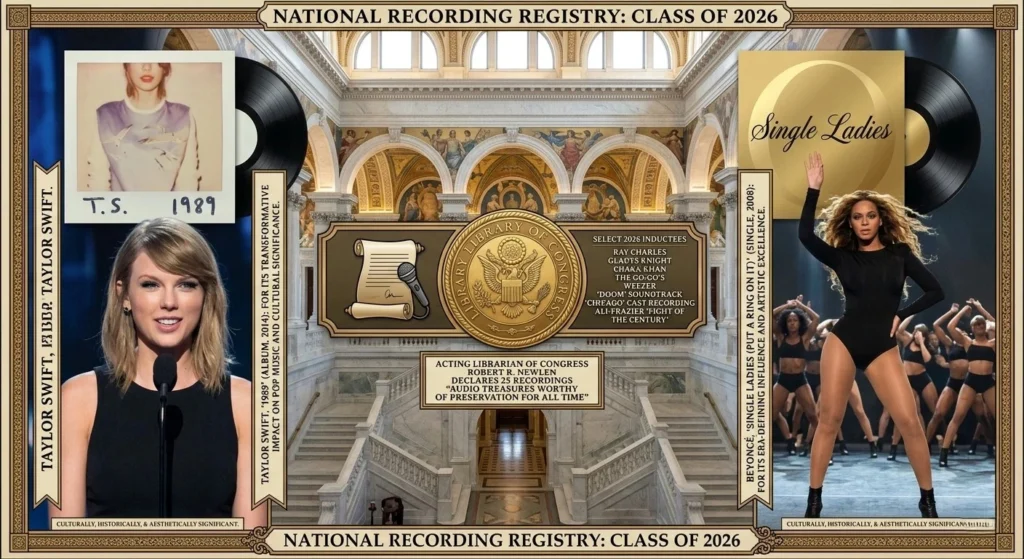
Table of Contents
Two of the biggest names in modern music history have officially been enshrined in America’s most prestigious audio archive. In May 2026, the Library of Congress announced that Taylor Swift’s career-defining album 1989 and Beyoncé’s era-shaping anthem “Single Ladies (Put a Ring on It)” have been inducted into the National Recording Registry, marking the first time either artist has received this honor. This is not just another award. The National Recording Registry is a permanent, government-curated collection of recordings deemed essential to America’s cultural, historical, and aesthetic heritage. Getting in means your music is considered a national treasure.
The announcement came as part of the Registry’s class of 2026, which includes 25 recordings spanning seven decades of American sound. For fans of both artists, this recognition confirms what the world already knew: these recordings didn’t just top charts, they changed culture. At a time when music preservation is increasingly urgent in the streaming era, the Library of Congress is making a bold statement about which sounds define us as a nation, and Swift and Beyoncé are now firmly on that list.
What Happened?
On May 14, 2026, Acting Librarian of Congress Robert R. Newlen officially announced the 25 newest inductees to the National Recording Registry. Among the most headline-grabbing selections were Taylor Swift’s 1989 (2014) and Beyoncé’s “Single Ladies (Put a Ring on It)” (2008).
These are described by the library as “audio treasures worthy of preservation for all time based on their cultural, historical, or aesthetic importance in the nation’s recorded sound heritage.” This marks the first time either artist has been selected for the Registry, a milestone that has surprised many observers who expected these artists to have been inducted years earlier.
Timeline of Key Events:
- 2008 — Beyoncé releases “Single Ladies (Put a Ring on It)” as part of her double album I Am… Sasha Fierce. It goes on to win Grammy Awards for Song of the Year, Best R&B Song, and Best Female R&B Vocal Performance, and reaches No. 1 on the Billboard Hot 100 for four weeks.
- 2014 — Taylor Swift releases 1989, her fifth studio album, marking a deliberate pivot from country to pure pop. It wins Album of the Year and Best Pop Vocal Album at the Grammys and spawns seven singles, including “Shake It Off.”
- 2023 — Swift re-records 1989 as 1989 (Taylor’s Version) after acquiring rights to her master recordings.
- May 14, 2026 — The Library of Congress officially selects both recordings for the National Recording Registry, Class of 2026.
Why Is This Trending?
The announcement immediately exploded across social media. Swifties and the Beyhive, two of the most dedicated fan communities on the internet, flooded platforms with celebratory posts, memes, and tributes. The hashtags #NationalRecordingRegistry, #1989, and #SingleLadies trended within hours of the Library of Congress announcement.
What makes this especially resonant is the timing: just months earlier, at the 67th Grammy Awards, Beyoncé famously accepted the Best Country Album award for Cowboy Carter from none other than Taylor Swift herself. The moment became one of the most talked-about images of 2025, and now both artists are being honored side by side again, this time by the U.S. government.
Music critics and historians noted that the selection of two living, active pop superstars, alongside classic recordings by Ray Charles and José Feliciano, signals the Registry is evolving to reflect the full breadth of 21st-century American music. Secondary keywords like Taylor Swift awards, Beyoncé achievements, and iconic albums dominated search trends in the days following the announcement, reflecting the enormous public interest in both artists’ ever-growing legacies.
Background and History
The National Recording Registry was established under the National Recording Preservation Act of 2000. Each year, the Librarian of Congress, in consultation with the National Recording Preservation Board, selects up to 25 recordings that are deemed “culturally, historically, or aesthetically significant.” To be eligible, a recording must be at least 10 years old.
The Registry is housed at the Library of Congress, which already holds one of the world’s largest collections of recorded sound, nearly 4 million items. The Registry itself, however, is highly selective, with only 700 recordings named as of the 2026 class. That means fewer than 0.02% of the Library’s holdings have earned this distinction.
Past Registry Inductees Include:
- Robert Johnson’s blues recordings
- Elvis Presley’s first Sun Records sessions
- The Beatles’ Abbey Road
- Miles Davis’s Kind of Blue
- Marvin Gaye’s What’s Going On
- Johnny Cash’s At Folsom Prison (inducted 2003)
The 2026 class adds a notable family footnote: Rosanne Cash’s The Wheel was inducted this year, making her and her father Johnny Cash the first parent-child duo both represented in the Registry.
Key Facts and Important Details
- What was selected for Taylor Swift: 1989 (2014), her fifth studio album and first fully pop record. The Library noted: “As she does so well, Swift used the songs in 1989 to examine matters of the heart. Seven singles, including the perennial favorite ‘Shake It Off,’ were released from this phenomenally successful album.”
- What was selected for Beyoncé: “Single Ladies (Put a Ring on It)” (2008). The Library stated: “Beyoncé’s blockbuster found itself embraced by all generations and fans of almost every musical style.”
- First-ever inductions for both Taylor Swift and Beyoncé in the Registry’s history.
- The 2026 class spans seven decades, from Spike Jones and His City Slickers’ “Cocktails for Two” (1944) to 1989 (2014).
- The Registry now includes 700 total recordings, a tiny fraction of the Library’s nearly 4 million collected recordings.
- Over 3,000 public nominations were submitted for the 2026 class, with Weezer among the most-nominated by fans.
- Other notable 2026 inductees include Ray Charles’s Modern Sounds in Country and Western Music, Reba McEntire’s Rumor Has It, Chaka Khan’s “I Feel for You,” The Go-Go’s Beauty and the Beat, Weezer’s self-titled “Blue Album,” the original cast recording of Chicago, José Feliciano’s “Feliz Navidad,” and the soundtrack to the 1993 video game Doom.
- The 2026 class also includes the radio broadcast of The Fight of the Century — Muhammad Ali vs. Joe Frazier, 1971.
- This is the third time video game music has been selected for the Registry.
- The 2026 class coincides with the United States’ 250th anniversary, which shaped the theme of the selections, per the National Recording Preservation Board.
Public and Industry Reactions
Fans responded with overwhelming enthusiasm across all platforms. Swifties pointed out the historic nature of 1989, the album widely credited with defining the sound of mid-2010s pop, earning a permanent place in the U.S. government’s cultural archive. Members of the Beyhive noted that “Single Ladies” had already become a pop culture shorthand for empowerment and celebration, and this recognition only cements that status.
Music critics and historians were broadly supportive of the choices, though some noted with gentle irony that both artists had been “eligible” for years. Given the Registry’s 10-year rule, 1989 became eligible in 2024, and “Single Ladies” became eligible in 2018. The swift (no pun intended) selection of 1989 in its first or second eligible year was seen as a testament to the album’s undeniable impact.
Industry insiders praised the Library of Congress for broadening the scope of the Registry to include contemporary artists alongside the historical recordings that have traditionally dominated the list. The National Recording Preservation Board’s chair, Robbin Ahrold, said in an official statement: “The sweep and diversity of the National Recording Registry class of 2026 beautifully captures the scope of the American experience as we celebrate our nation’s 250th anniversary. From icons of R&B to a holiday favorite en Español, from a legendary sports broadcast to this generation’s superstars, it is a thrilling reflection of America at its best.”
Vince Gill, whose “Go Rest High on That Mountain” was also inducted, told media that the song is one people seek out during their hardest moments, a reflection of the deeply personal power music preservation is meant to honor.
Belinda Carlisle of The Go-Go’s expressed her excitement at Beauty and the Beat making the list, calling the all-female rock band’s 1981 debut a milestone for women in music, a sentiment echoed widely in coverage of the announcement.
What Happens Next?
For the Registry:
Public nominations for the 2027 class are already open and will be accepted through October 1, 2026. Music fans can submit their picks via the Library of Congress website. Given this year’s enthusiasm around contemporary artists, expect a surge in nominations for modern recordings.
For Taylor Swift:
1989 joining the Registry adds yet another milestone to one of the most decorated discographies in music history. With the Eras Tour having wrapped and re-recordings of her catalog complete, Swift’s legacy is increasingly being assessed by cultural institutions, not just the pop charts.
For Beyoncé:
“Single Ladies” in the Registry sits alongside Cowboy Carter’s historic Grammy wins in a remarkable stretch for the artist. Beyoncé has continued to push genre boundaries, and many expect other recordings from her catalog, including Lemonade and Renaissance, to eventually join the Registry as they become eligible.
For music preservation broadly:
The 2026 class, with its blend of video game soundtracks, boxing broadcasts, Latin music, Broadway recordings, and 21st-century pop, suggests the Library of Congress is committed to reflecting the full diversity of American sound, not just classical or legacy rock. As streaming continues to reshape how music is consumed, the Registry’s role in ensuring these recordings survive for future generations becomes more important than ever.
Conclusion
The addition of Taylor Swift’s 1989 and Beyoncé’s “Single Ladies” to the National Recording Registry is more than a headline, it’s a formal acknowledgment that 21st-century pop has produced recordings worthy of permanent preservation alongside the greatest sounds in American history. The Library of Congress has spoken: these aren’t just hits. They’re history.
The 2026 class, spanning seven decades and genres from jazz to video game scores, reflects a Registry growing bolder in its recognition of contemporary culture. As both artists continue to evolve and as their catalogs age into eligibility, this is almost certainly not the last time Swift or Beyoncé will appear on this list. Lemonade, Cowboy Carter, Fearless — the question now is not if they’ll return, but when.
For fans, the inductees offer the perfect prompt to revisit these recordings, not just as entertainment, but as cultural artifacts that define a generation. And for anyone who wants to shape history, the Library of Congress is accepting nominations for next year’s class right now.
FAQs
1. Why is the National Recording Registry important?
The National Recording Registry is the United States government’s official list of culturally, historica lly, and aesthetically significant recordings. Being inducted means a recording is considered part of America’s national heritage — preserved by the Library of Congress for future generations. It’s one of the highest honors a recorded work can receive in the United States.
2. What does it mean for Taylor Swift and Beyoncé to be added?
It’s a formal government recognition that their work has had lasting cultural and historical impact — beyond sales figures, streaming numbers, or awards. The Registry is selective by design, with only 25 recordings added per year, making inclusion a genuinely rare distinction.
3. Which specific recordings were selected?
Taylor Swift’s 1989 (2014) and Beyoncé’s “Single Ladies (Put a Ring on It)” (2008) were chosen for the Class of 2026.
4. Who decides what gets added to the National Recording Registry?
The Librarian of Congress makes the final selections in consultation with the National Recording Preservation Board. Public nominations are also accepted — over 3,000 were submitted for the 2026 class.
5. Where can I listen to the 2026 Registry inductees?
Many of the recordings are available on major streaming platforms. The Digital Media Association, a member of the National Recording Preservation Board, has compiled a playlist of streaming links at dima.org/playlist.
6. When did this happen?
The Library of Congress announced the 2026 National Recording Registry class on May 14, 2026.
7. How many recordings are now in the Registry?
The 2026 class brings the total to 700 recordings, selected from the Library’s collection of nearly 4 million recorded items.
8. Can the public nominate recordings?
Yes. Nominations for the 2027 class are open now and close on October 1, 2026, via the Library of Congress website.