The Case for the ‘Analog Split’: Why the Traditional Tech Desk is Dying
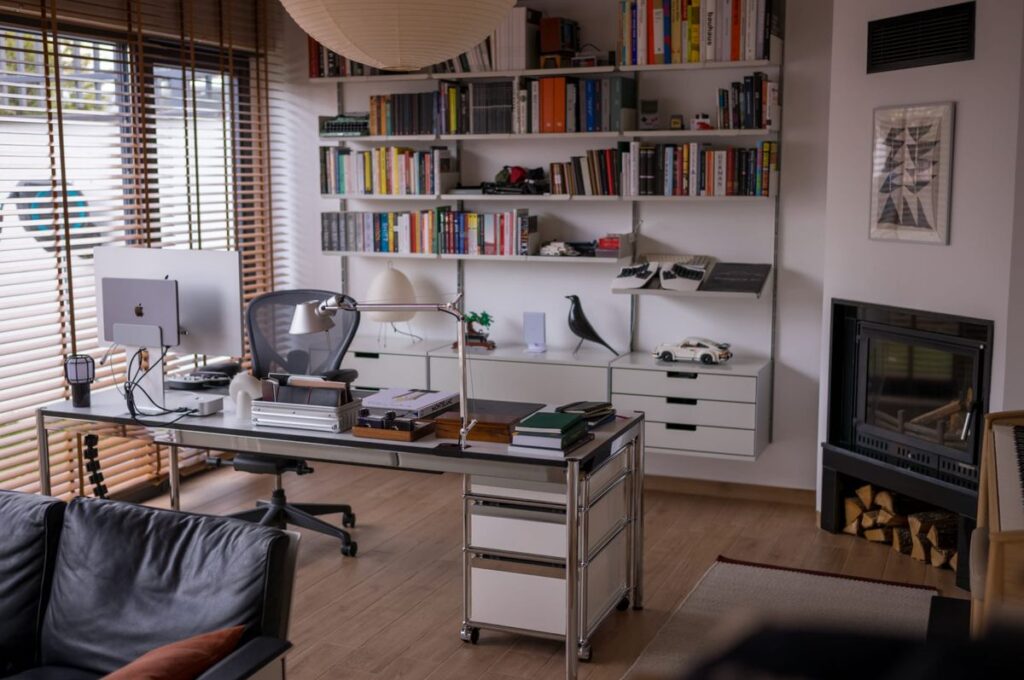
Table of Contents
Beyond the Wall: The Psychology of Workspace Orientation
For the better part of a decade, the default configuration for the home office has remained largely unchanged: a desk pushed flush against a wall, a monitor centered in the field of vision, and a user staring directly into a partition. It is an efficient arrangement for cable management, but it creates a psychological dead-end.
The shift toward ‘room-facing’ setups is gaining traction as professionals realize that the physical orientation of a workspace fundamentally alters mental clarity. By rotating the desk to face the interior of the room, the user gains a sense of depth and spatial awareness. No longer staring at a drywall boundary, the field of vision opens up, reducing the claustrophobic feeling often associated with deep-work marathons. More importantly, it changes the power dynamic of the room; facing the door and the living space creates a subconscious sense of security and openness that a wall-facing setup lacks.
The Digital Monopoly
However, orientation is only half the battle. The more pressing issue for the modern knowledge worker is the ‘digital monopoly’—the tendency for the computer to dominate every square inch of the available surface area. In a traditional tech-centric setup, the monitor, keyboard, and mouse act as a gravitational center, pulling every activity into a screen-based mode of operation.
When a workspace is designed solely for technical tasks, activities like journaling, project sketching, or strategic planning are forced to compete with the glow of a 5K display. The result is often a fragmented focus where the user is constantly pushing a keyboard aside to make room for a notebook, or worse, abandoning the analog process entirely in favor of a digital app that doesn’t actually improve the creative flow.
Designing the Hybrid Surface
The solution emerging among designers and power users is the ‘Analog Split.’ Rather than maintaining two separate pieces of furniture—which is often impractical in modern apartments—the strategy employs a single, oversized surface divided into two distinct functional zones. A prime example of this is the use of modular systems like the USM Haller, where a long, 200cm surface can be carved into two dedicated territories.
The Digital Zone
The first half of the desk is the ‘Digital Side.’ This is the high-efficiency zone, typically characterized by a minimal footprint. Here, the hardware—such as a Mac, a Studio Display, and specialized peripherals like a split keyboard—is the sole focus. By keeping this area intentionally sparse, the mental association is clear: when you slide your chair into this zone, you are in ‘execution mode.’ The goal is to eliminate friction and distractions, ensuring that the only tools present are those required for coding, writing, or communication.
The Analog Zone
The opposite side of the desk serves as the ‘Analog Side.’ This area is deliberately screen-free, reserved for tactile interaction. It is a space for journals, physical planners, and DIY projects. Unlike the digital side, the analog zone does not need to adhere to the strict laws of minimalism. It can be functional, inviting, and even messy. Because there is no screen to compete with, this zone becomes a sanctuary for deep thought and ideation.
The Cognitive Shift
The primary benefit of the split-desk layout isn’t just organizational; it’s cognitive. Moving a chair six inches to the left creates a physical and mental boundary. It signals to the brain that the context has changed from ‘output’ (digital) to ‘input’ or ‘reflection’ (analog).
This hybrid approach acknowledges a growing truth in the age of AI and ubiquitous screens: minimalism in design does not always equate to minimalism in mind. While a clean desk looks good on social media, a sterile environment can occasionally stifle the chaotic energy required for genuine creativity. By blending a minimalist digital station with a maximalist analog workspace, users can maintain professional efficiency without sacrificing the tactile habits that fuel innovation.


