The Asus ROG Zephyrus G14 Is Now the Perfect Laptop for Everyone Except the Budget-Conscious
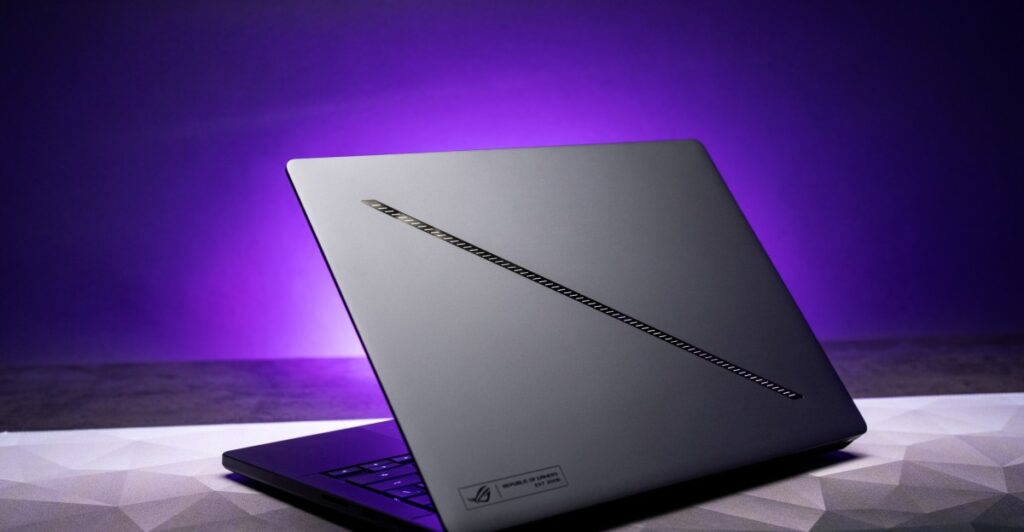
Table of Contents
A shift in silicon and strategy
For years, the Asus ROG Zephyrus G14 has occupied a rare space in the laptop market: the “do-everything” machine. It managed to balance the raw power required for AAA gaming with the portability and aesthetic restraint needed for a professional boardroom. However, the 2026 iteration marks a fundamental shift in both the machine’s internals and its market positioning.
The most significant change is under the hood. Asus has transitioned the G14 from its long-standing partnership with AMD to Intel’s new Panther Lake architecture. This move, paired with the introduction of a full-size SD card slot—a feature long requested by creators—positions the G14 more as a high-end workstation that happens to game, rather than just a gaming laptop.
The cost of performance
While the hardware is impressive, the pricing is jarring. The 2026 models now start at $3,450, with the high-spec review configuration reaching $3,600. To put this in perspective, earlier generations of the G14 frequently started in the low $1,000s, offering a value proposition that made it an easy recommendation for students and freelancers alike. That era is officially over.
This price creep is partly attributed to the broader industry trend of “RAMageddon,” where the surge in AI data center demand has driven up the cost of high-speed memory and SSDs. Yet, the math still feels skewed. The review unit, equipped with an Intel Core Ultra 9 386H and an Nvidia GeForce RTX 5070 Ti, costs roughly $1,000 more than a nearly identical last-gen AMD configuration. While Asus continues to sell previous-generation models to provide a cheaper entry point, the flagship experience is now firmly in the luxury tier.
Refining the chassis
Physically, the G14 remains a masterclass in compact engineering. It retains the sleek, MacBook Pro-adjacent footprint of the 2024 redesign but introduces subtle cosmetic tweaks. The animated slash lighting on the lid now features more LED segments, and the bottom cover has transitioned from rectangular slots to circular hole vents for improved thermal management.
The 2880 x 1800 OLED display remains the center attraction. It is noticeably brighter than the 2025 model, hitting 500 nits in SDR and peaking at 1,100 nits in HDR. This makes the screen viable for outdoor work and high-impact gaming. Complementing the visuals is a six-speaker array that delivers a rich, wide soundstage—one of the few Windows implementations that can legitimately compete with Apple’s audio engineering.
Real-world productivity and gaming
In practice, the Panther Lake chip excels in efficiency. One of the most frustrating aspects of Windows gaming laptops has always been the precipitous drop in performance when unplugged. The G14 mitigates this; multicore and GPU performance remain remarkably stable on battery power.
During testing with Adobe Lightroom Classic, the G14 handled hundreds of 50-megapixel RAW photos with ease. Culling and rating images felt instantaneous, and while heavy batch processing eventually triggered the fans, the machine maintained a steady flow without throttling into Energy Saver mode. For those who game, the peak TGP of 130W allows the RTX 5070 Ti to push frames with a slight edge over the 120W limit of the previous generation.
There are minor gripes—the webcam remains grainy in low-light environments and the SSD read/write speeds are roughly 12 percent slower than the predecessor—but these are footnotes in an otherwise stellar package. The keyboard and trackpad remain industry-leading, providing a tactile, firm response that makes long writing sessions comfortable.
The verdict on value
The 2026 Zephyrus G14 is arguably the best 14-inch Windows laptop Asus has ever built. It is a powerhouse that doesn’t scream “gamer” and a creative tool that doesn’t compromise on GPU power. But at $3,600, it is no longer a tool for the masses; it is a precision instrument for those whose budgets are as flexible as the laptop’s utility.