Home / Why Did Protests Disrupt Israel’s Eurovision Performance?
Why Did Protests Disrupt Israel’s Eurovision Performance?
Saran K | May 23, 2026 | 9 min read
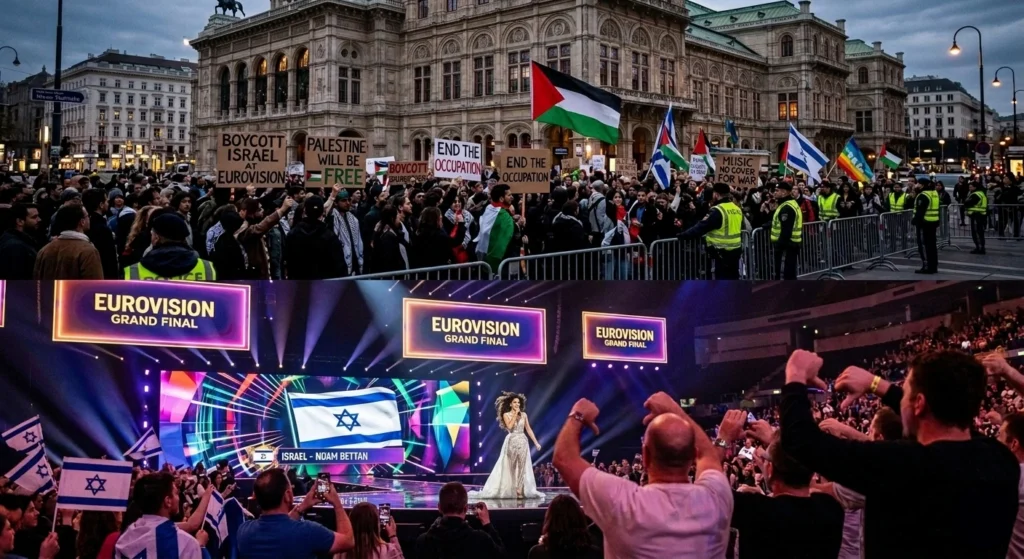
Table of Contents
The 70th Eurovision Song Contest in Vienna was supposed to be a celebration — glittery, joyful, and unifying. Instead, it became one of the most politically charged editions in the competition’s history. Israel’s participation in Eurovision 2026 triggered protests both inside and outside Vienna’s Wiener Stadthalle, five country boycotts, and a global debate about whether pop music and geopolitics can coexist on the same stage.
At the center of it all was Israeli singer Noam Bettan, who performed his pop ballad Michelle under extraordinary pressure, even rehearsing for months with simulated boos. Despite the disruptions, Israel ultimately finished second, receiving 220 public vote points and sparking a mixed chorus of cheers and jeers heard live on air across Europe.
The Eurovision Israel protest has trended across social media ever since, with audiences worldwide split between artistic solidarity and political outrage. Here’s a full breakdown of what happened, why it matters, and what comes next.
What Happened?
The 2026 Eurovision Song Contest took place on May 16, 2026, in Vienna, Austria, marking the competition’s 70th anniversary. Israel was represented by 28-year-old singer Noam Bettan, performing his song, Michelle.
From the very first semifinal on May 12, Bettan’s performances were met with disruption. Pro-Palestinian protesters inside the venue shouted chants and were removed by security. Outside the Wiener Stadthalle, hundreds of demonstrators gathered holding Palestinian flags and banners, marching toward the arena, which was secured by police barriers.
During the grand finale, when Israel surged into the lead during the public vote, audible boos and cheers erupted in the hall. BBC presenter Graham Norton noted on air, “Quite a strong reaction to that in the hall” as the results came in. When Israel was awarded 220 public vote points, Bettan pumped his fist on stage — a moment that went instantly viral.
Israel ultimately finished second, behind Bulgaria’s pop star Dara.
Timeline of Key Events
- December 2025 — Ireland, Netherlands, Slovenia, Spain, and Iceland announce boycotts after the EBU declines to hold a vote on Israel’s participation.
- December 2025 — Eurovision 2025 winner Nemo returns their trophy in protest; Ireland’s 1994 winner Charlie McGettigan does the same.
- March 2026 — Eurovision 2026 semi-final draw places Israel in the first semi-final.
- May 12, 2026 — First semifinal; Bettan is heckled by protesters inside the venue.
- May 16, 2026 — Grand final held in Vienna; protests outside, boos inside; Israel finishes second.
Why Is This Trending?
The Eurovision Israel protest became a flashpoint because it sits at the intersection of mass entertainment, international politics, and ongoing humanitarian crisis. Eurovision typically draws over 100 million viewers, making it one of the most-watched non-sporting events in the world, meaning any controversy plays out on a massive stage.
Several factors sent this story trending globally:
The boycotts were unprecedented. Five countries — Spain, Ireland, Iceland, the Netherlands, and Slovenia, simultaneously withdrew from the competition. Spanish Prime Minister Pedro Sánchez personally posted on social media that his country would not be in Vienna, saying they were acting “on the right side of history.”
The boos were broadcast live. The moment Israel received its public vote tally, the mixed crowd reaction was captured on air across dozens of national broadcasts, creating hundreds of viral clips shared on X (formerly Twitter), TikTok, and Instagram.
Bettan’s boo rehearsals became a story of their own. Reports that the Israeli singer had been training for months with simulated heckling sparked intense online discussion — admiration from some, outrage from others.
The EBU’s refusal to exclude Israel drew criticism from broadcasters and artists who argued the organization was prioritizing revenue over human rights.
Background and History
Israel has been participating in Eurovision since 1973 and has won the contest four times. Historically, the country’s inclusion rarely made headlines.
That changed in October 2023, when Hamas militants launched attacks on southern Israel, killing approximately 1,200 people and taking 251 hostages. Israel’s subsequent military campaign in Gaza, which has resulted in over 72,000 Palestinian deaths according to Hamas-run health authorities, transformed Eurovision into an unlikely battleground for protest.
Eurovision 2024 (Malmö, Sweden) was the first edition heavily affected, with thousands marching in the streets and protests, including one involving climate activist Greta Thunberg, taking place outside the venue.
Eurovision 2025 (Basel, Switzerland) escalated further. Israeli contestant Yuval Raphael, a survivor of the October 7 Nova music festival attack, attended the turquoise carpet ceremony only to have a protester allegedly make a threatening gesture toward her. Pro-Palestinian demonstrators clashed with riot police in the city center on the night of the final.
Eurovision 2026 (Vienna) marked the third consecutive year of major controversy, though authorities noted the Vienna protests remained smaller than those in Malmö and Basel.
The European Broadcasting Union (EBU), which organizes Eurovision, has consistently declined to suspend or expel Israeli broadcaster KAN, citing its rules that the contest is a non-political, cultural event.
Key Facts and Important Details
- Israel’s 2026 act: Noam Bettan, 28, born in Israel to French immigrant parents, performing Michelle
- Final result: Israel finished 2nd, behind Bulgaria’s Dara
- Public vote score: 220 points — one of the highest public tallies of the night
- Countries boycotting 2026: Spain, Ireland, Iceland, the Netherlands, Slovenia (5 countries)
- Reason given by boycotting broadcasters: Ongoing war in Gaza, humanitarian crisis, and Israel’s alleged use of the contest for political purposes
- EBU decision: Declined to hold a vote on Israel’s exclusion; instead introduced new voting rules to “reinforce trust and protect neutrality”
- Security in Vienna: Police deployed from across Austria plus additional forces from Germany
- Palestinian casualties: More than 72,000 killed in Gaza since October 2023, per Hamas-run health authorities; 871 deaths reported since a ceasefire came into force in October 2025
- ORF’s stance: Austrian host broadcaster confirmed it would not prohibit Palestinian flags or drown out booing directed at Israel’s performance
- Notable protest: An anti-Israel solidarity concerts the day before the final included a video call with author Deborah Feldman; a separate street protest escalated in its chants
Public and Industry Reactions
Inside the venue, the reaction to Israel was starkly divided — loud boos and cheers erupted simultaneously when Israel took the lead, creating an uncomfortable live moment broadcasted across Europe.
Boycotting broadcasters were clear in their reasoning. Dutch broadcaster AVROTROS said Israel’s participation “cannot be reconciled with the public values that are fundamental to our organisation.” Ireland’s RTÉ pointed to “the appalling loss of lives in Gaza,” and Slovenia’s broadcaster said it was acting “on behalf of the 20,000 children who died in Gaza.”
Supporters of Israel’s inclusion pushed back hard. Israeli President Isaac Herzog welcomed the EBU ruling, writing that “Israel deserves to be represented on every stage around the world.” Germany, a major Eurovision backer, had also signaled it would not participate if Israel were barred.
Fans online were sharply split. Pro-Palestinian supporters called for Eurovision to take a principled stand, while others argued the contest should remain a politics-free zone and that boycotts unfairly punish an artist for state actions.
In the broader arts world, a collective of 170 Belgian artists denounced their broadcaster’s decision to participate. Hundreds of musicians signed an open letter urging Live Nation to drop operations in Israel. An Italian broadcast workers’ union at RAI launched a petition calling for Italy to boycott Eurovision 2026.
Media coverage globally framed the contest as a test case for whether cultural institutions can remain “neutral” during active geopolitical conflicts — with many commentators concluding they cannot.
What Happens Next?
The controversy surrounding Eurovision and Israel shows no sign of fading before the 2027 contest, which will be hosted by Bulgaria following Dara’s victory in Vienna.
Several developments are already in motion:
More boycotts may follow. With five countries already out and artists across Europe continuing to publicly oppose Israel’s inclusion, pressure on the EBU is mounting for the 2027 edition.
The EBU’s new voting rules — which limit individual viewers to 10 votes (down from 20) and adjust the jury/public split, will be closely watched to see whether they reduce or amplify political influence in outcomes.
Israel’s strong public vote result in Vienna has intensified accusations from some broadcasters that public voting has become a vehicle for political solidarity rather than artistic merit, a debate that will shape future EBU policy discussions.
The broader culture war around “art-washing” — the charge that participating in Eurovision normalizes or rehabilitates Israel’s international image during the war, is likely to intensify, especially with Palestinian casualties continuing to mount.
Watch for broadcaster announcements in late 2026 as countries formally commit to or withdraw from Eurovision 2027 in Bulgaria.
Conclusion
The Eurovision Israel protest in Vienna was not an isolated incident, it was the third consecutive year the song contest has been engulfed in political controversy, and the most organized to date, with five countries boycotting, hundreds protesting outside the venue, and audiences booing live on air across Europe.
At its core, the debate is about something larger than pop music: whether cultural institutions bear a moral responsibility to respond to human rights crises, or whether art should remain a sanctuary from political conflict. Eurovision has long positioned itself as a celebration of unity, but the events of 2024, 2025, and 2026 suggest that unity is increasingly hard to manufacture when the world outside is fractured.
As the contest moves to Bulgaria for 2027, expect the debate to intensify, with more boycott threats, EBU policy battles, and perhaps even greater protests on the streets of the host city.
FAQs
Why is the Eurovision Israel protest important?
It reflects a broader global debate about whether cultural events can or should remain apolitical during active wars. Eurovision’s massive audience, over 100 million viewers mean the protests and boycotts receive worldwide attention, amplifying calls for accountability.
What does the Eurovision Israel controversy mean for the contest?
It puts the EBU under sustained pressure to either revise its membership and eligibility rules or risk losing key participating countries. It also raises fundamental questions about what “neutrality” means for a publicly funded, pan-European institution.
Where can I watch the Eurovision 2026 final?
The full 2026 Eurovision grand finale, including Israel’s performance by Noam Bettan, is available on YouTube via the official Eurovision Song Contest channel and on the streaming platforms of various national broadcasters.
Who is involved in the Eurovision Israel protest?
The protests involve pro-Palestinian activists, boycotting national broadcasters (Spain, Ireland, Iceland, Netherlands, Slovenia), cultural figures (artists, musicians, authors), and political leaders including the Spanish Prime Minister. The EBU, Israeli broadcaster KAN, and the competing artist Noam Bettan are at the center of the controversy.
When did Eurovision Israel protests start?
Protests at the contest itself began at Eurovision 2024 in Malmö, Sweden, following Israel’s military campaign in Gaza after the October 7, 2023 Hamas attacks. Controversy has grown each year since.
Did Israel win Eurovision 2026?
No. Israel finished second, behind Bulgaria’s Dara. Israel received 220 public vote points, among the highest of the night, but the jury vote determined Bulgaria’s victory.