AMD Challenges Nvidia’s AI Workstation Dominance with $3,999 Ryzen AI Halo
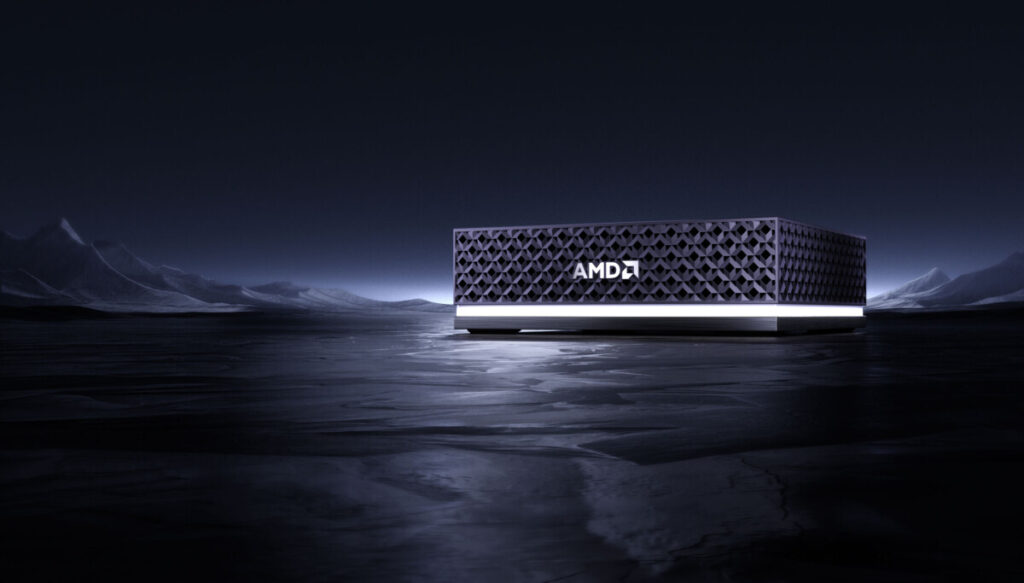
Table of Contents
A High-Stakes Bet on Local AI
AMD is stepping directly into the high-end developer market with the announcement of the Ryzen AI Halo, a compact workstation designed to move AI development away from expensive cloud APIs and into the local office. With a starting price of $3,999, the device is positioned as a direct competitor to Nvidia’s DGX Spark, targeting the growing segment of “vibe coders” and machine learning engineers who require heavy lifting without the latency or cost of remote servers.
AMD’s marketing lean heavily on the economics of local compute. According to the company, a developer spending eight hours a day on AI-driven coding tasks could save roughly $750 per month in cloud API fees by running models locally. While that pitch makes the $4,000 entry price seem like a short-term investment, it also highlights the volatility of the current hardware market; similar specs were available for significantly less than a year ago, a trend AMD attributes to the broader industry-wide surge in memory costs.
The Silicon Under the Hood
At the heart of the AI Halo is the 120-watt Ryzen AI Max+ 395 APU, better known by its codename, Strix Halo. This isn’t a typical consumer chip. It packs 16 Zen 5 cores and 40 RDNA 3.5 GPU compute units, all supported by 128 GB of LPDDR5x memory clocked at 8000 MT/s. This configuration provides a massive 256 GB/s of bandwidth—outperforming even non-Pro Ryzen 9000 Threadripper systems.
For those specializing in Large Language Models (LLMs), this memory overhead is the critical metric. The AI Halo can run models with up to 200 billion parameters at 4-bit precision, placing it in the same league as the more expensive Nvidia Spark. However, the raw compute tells a different story. The integrated graphics deliver roughly 56 teraFLOPS at 16-bit precision, which is significantly lower than the Blackwell-based GB10 APU found in the Spark. Because Strix Halo lacks hardware support for FP8 or FP4 data types, it cannot match Nvidia’s peak theoretical throughput in specialized workloads.
Performance Realities: Tokens vs. Processing
Despite the gap in raw teraFLOPS, AMD claims the AI Halo actually generates tokens 4-14% faster than the Spark in certain LLM inference tasks. This is a nuance of AI hardware: token generation speed is often capped by memory bandwidth rather than raw compute power. If the data can get to the cores fast enough, the difference in floating-point performance becomes less relevant.
Where Nvidia still holds a commanding lead is in prompt processing. Thanks to superior tensor cores, the DGX Spark typically processes initial prompts 2x to 3x faster than AMD’s offering. While a 100ms difference is negligible for a short query, it becomes a tangible bottleneck when dealing with massive context windows or complex system prompts.
OS Flexibility and the Software Moat
Where the Ryzen AI Halo gains a distinct advantage is in its openness. Unlike the DGX Spark, which locks users into a customized version of Ubuntu 24.04, the AI Halo is a standard x86 machine. Users can install Windows or any preferred Linux distribution, making it an ideal platform for developers building within Microsoft’s NPU-accelerated ecosystem.
AMD has also integrated an XDNA 2-based NPU rated for 50 TOPS. While the industry is still figuring out how to fully leverage NPUs for generative AI inference, the inclusion provides a dedicated path for low-power background tasks that would otherwise eat into the GPU’s budget.
Perhaps more importantly, AMD is attempting to solve the “dependency hell” that plagues AI development. The AI Halo will ship with five preinstalled “playbooks”—validated software environments for tools like vLLM, Llama.cpp, and Ollama. By providing a known-good configuration of ROCm and PyTorch, AMD hopes to reduce the time developers spend debugging drivers and increase the time they spend building.
The Connectivity Gap
The one area where the AI Halo falls short is networking. Nvidia’s Spark features a 200 Gbps ConnectX-7 NIC, allowing developers to cluster multiple units together for massive parallel workloads. AMD has opted for a single 10 Gbps NIC. While USB-4 could theoretically provide higher speeds through RDMA, as seen in some Apple Silicon implementations, AMD has not yet clarified if this is a supported or optimized use case for the Halo.
Pre-orders for the 128 GB model begin next month at $3,999, with higher-specification configurations expected to follow.