Home / What Does the Met Museum and Neue Galerie Merger Mean for the Art World?
What Does the Met Museum and Neue Galerie Merger Mean for the Art World?
Saran K | May 21, 2026 | 10 min read
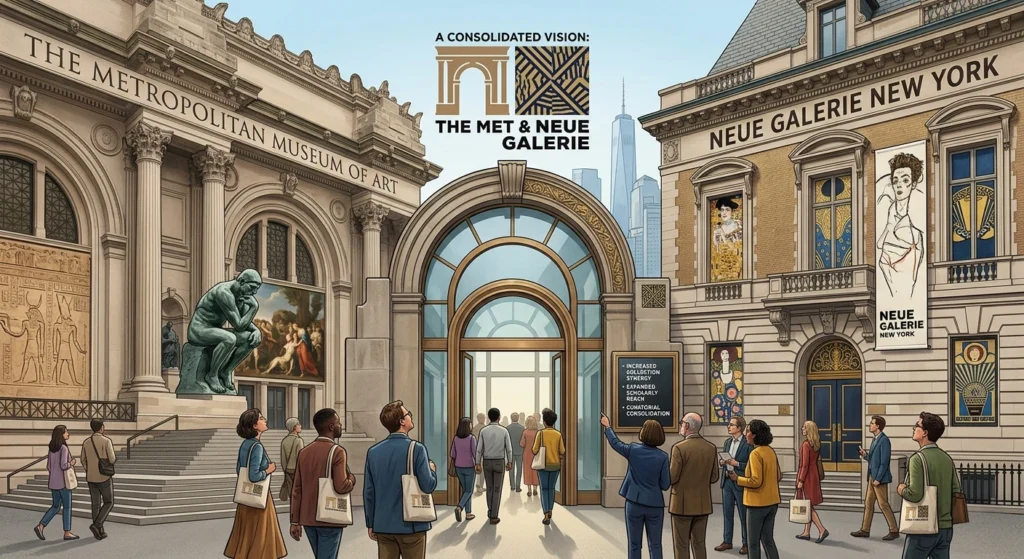
Table of Contents
The art world is buzzing after one of the most significant museum announcements in decades. In May 2026, the Metropolitan Museum of Art and the Neue Galerie New York officially announced plans for a landmark merger, one that will unite the most important collection of 20th-century Austrian and German art outside Europe under a single institution.
The Met Museum merger with the Neue Galerie is set to take effect in 2028, bringing Gustav Klimt’s iconic Portrait of Adele Bloch-Bauer I, known as the “Woman in Gold”, along with works by Egon Schiele, Oskar Kokoschka, and Max Beckmann under the broader umbrella of The Met. Yet unlike typical institutional absorptions, the Neue Galerie will retain its Fifth Avenue home, its beloved Café Sabarsky, and its distinctive cultural identity.
This is not just a business deal — it’s a generational act of stewardship that promises to reshape how New York, and the world, engages with early modernist art.
A Historic Merger
On May 14, 2026, The Metropolitan Museum of Art and the Ronald S. Lauder Neue Galerie New York jointly announced plans for a historic merger to be finalized in 2028. Under the agreement, The Met will take ownership of the Neue Galerie’s Beaux-Arts building, the six-story William Starr Miller House at the corner of Fifth Avenue and 86th Street as well as its world-class collection.
The merged institution will be renamed the Met Ronald S. Lauder Neue Galerie, or the “Met Neue Galerie” for short. It will continue to operate as a standalone cultural destination, preserving its current programming, exhibitions, and the atmospheric Viennese-style experience it has cultivated since its founding.
As part of the agreement, Ronald S. Lauder and his daughter Aerin Lauder Zinterhofer will donate 13 artworks from their personal collection to the combined institution, including Klimt’s monumental Die Tänzerin (The Dancer) (circa 1916–18) and Ernst Ludwig Kirchner’s Die Russische Tänzerin Mela (1911).
Timeline at a Glance
- November 2001 — Neue Galerie opens on Fifth Avenue, co-founded by Ronald S. Lauder and art dealer Serge Sabarsky
- 2006 — Max Hollein (now The Met’s Director) joins the Neue Galerie’s board
- 2020 — Lauder donates 91 objects from his arms and armor collection to The Met
- May 14, 2026 — Landmark merger announcement made public
- May 27, 2026 — Neue Galerie temporarily closes for renovations
- Autumn 2026 — Neue Galerie reopens with its 25th Anniversary Exhibition
- 2028 — Merger officially takes effect
Why Is This Trending?
The announcement immediately dominated art-world headlines, social media timelines, and cultural commentary platforms. Here’s why:
It involves the “Woman in Gold.” The Portrait of Adele Bloch-Bauer I — famously purchased by Lauder for $135 million in 2006 and immortalized in a Hollywood film, is at the center of the story. The prospect of this landmark work becoming part of The Met’s permanent collection is electrifying for art lovers globally.
It fills a major gap in The Met’s holdings. As Met Director Max Hollein acknowledged, the museum’s collection of Austrian and German modernism from the turn of the 20th century has always been a weak point. The merger addresses this head-on, bolstering the Neue Galerie collection within one of the world’s most visited museums.
It’s a model merger. Unlike institutional takeovers that erase identity, this deal preserves the Neue Galerie’s cultural DNA, its building, staff, café, and curatorial voice remain intact. The art community has taken note of how this precedent could shape future museum consolidations.
Social media reactions have ranged from enthusiastic praise to thoughtful concern. Many commentators celebrated the long-term preservation of the Gustav Klimt art and other priceless works. Others raised questions about the independence of specialty museums and what “merger” truly means when the absorbed institution retains its brand and location.
Background and History
The Neue Galerie was co-founded in November 2001 by Ronald S. Lauder — heir to the Estée Lauder cosmetics empire, former U.S. Ambassador to Austria, and one of the world’s most committed collectors of Austrian and German modernist art, alongside the late Viennese art dealer Serge Sabarsky, who died five years before the museum opened.
From the beginning, the Neue Galerie positioned itself not merely as a gallery but as a cultural immersion experience, a slice of early 20th-century Vienna transported to the Upper East Side. Its Café Sabarsky, named in honor of Serge Sabarsky, became as iconic as the art on its walls.
The relationship between Lauder and Max Hollein is equally storied. Hollein, who was born in Vienna and went on to lead institutions in Frankfurt and San Francisco before joining The Met in 2018, joined the Neue Galerie’s board in 2006. Their decades of collaboration laid the personal and professional groundwork for this merger.
The deal also echoes a precedent set nearly 80 years ago, when The Met absorbed the Museum of Costume Art in 1946, creating its now-famous Costume Institute, the institution behind the annual Met Gala. The Neue Galerie merger is considered far more significant in scale, but similarly transformative in vision.
Key Facts and Important Details
- Announcement date: May 14, 2026
- Merger completion target: 2028, pending regulatory approvals
- New name: Met Ronald S. Lauder Neue Galerie (informally, “Met Neue Galerie”)
- Location preserved: 1048 Fifth Avenue (corner of 86th Street), New York City
- Flagship artwork: Portrait of Adele Bloch-Bauer I (1907) by Gustav Klimt — purchased for $135 million; Lauder calls it “our Mona Lisa”
- Personal art donation: 13 works from Lauder and Aerin Lauder Zinterhofer’s private collection, including pieces by Klimt, Kirchner, Otto Dix, George Grosz, and Christian Schad
- Endowment requirement: The Met must raise $200 million to steward the Neue Galerie; Lauder and his daughter have committed a significant portion
- Visitors to date: Over 2 million since the Neue Galerie opened
- Building: Six-story Beaux-Arts mansion (William Starr Miller House), designed by Carrère & Hastings in 1914, the same firm that designed the New York Public Library
- The Met’s broader capital campaign: $1.5 billion in renovations underway, including the upcoming Tang Wing for Modern and Contemporary Art (opening 2030, designed by architect Frida Escobedo, spanning 126,000 sq ft)
- Other Met satellites: The Met Cloisters (medieval art, Fort Tryon Park) is the model Lauder cited for how the Neue Galerie might operate post-merger
Public and Industry Reactions
Ronald S. Lauder framed the merger as an act of legacy and love: “For the past twenty-five years, the Neue Galerie’s exhibitions, permanent collection, design and book shops, and Café Sabarsky have created an experience that transports visitors to another time, early twentieth-century Vienna and Weimar Germany. The merger with The Met in 2028 will preserve and strengthen the Neue Galerie’s legacy in perpetuity.”
Max Hollein, The Met’s Director and CEO, who called the deal “one of the greatest and biggest gifts ever given to a museum” added: “Ronald has established a museum that is itself a work of art, and ultimately a profound reflection of his passion, expertise, and philanthropy.”
Aerin Lauder Zinterhofer, a Met trustee herself, said: “To see it join The Met is incredibly meaningful. It ensures these works will continue to be preserved, studied, and shared with the widest possible audience for generations to come.”
In the broader art museum expansion community, experts have largely praised the move as a thoughtful solution to the sustainability challenges facing smaller, mission-driven institutions. The Neue Galerie model, a specialist museum with deep cultural immersion rather than encyclopedic breadth is expensive to maintain and faces real long-term pressures. The merger, analysts suggest, offers a path forward without compromising artistic integrity.
More than two dozen Met trustees have already pledged funds in support of the merger, led by longtime trustee Marina Kellen French.
Media coverage across The New York Times, The Art Newspaper, ARTnews, and Artnet has been extensive and largely favorable, with many noting this as a watershed moment for the New York museums landscape.
What Happens Next?
For the Neue Galerie
The museum closes May 27, 2026, for planned renovations to its landmark Beaux-Arts mansion. It is expected to reopen in Autumn 2026 with a major 25th Anniversary Exhibition — a milestone celebration of a quarter-century of cultural impact.
For The Met
In parallel with the merger preparations, The Met is deep into its $1.5 billion capital campaign. The new Tang Wing for Modern and Contemporary Art — designed by Frida Escobedo at a cost of $550 million across 126,000 square feet — opens in 2030. The Neue Galerie merger will complement, not compete with, this vision: the two collections address distinct but related chapters of early modernism.
For the art world at large
The merger could inspire other specialty museums and private foundations to explore similar arrangements with larger institutions — particularly as endowment pressures, staffing costs, and audience development challenges mount for smaller venues.
For the Ronald Lauder collection
The 13 works being donated from Lauder and his daughter’s personal collections will significantly deepen the merged institution’s holdings. Most notably, the Portrait of Adele Bloch-Bauer I will remain at 86th Street, staying in the intimate townhouse setting Lauder always intended for it.
Conclusion
The Met Museum merger with the Neue Galerie is more than an institutional transaction, it is a cultural act of preservation. For 25 years, Ronald S. Lauder built something rare: a museum that felt less like a repository and more like a living world, transporting its visitors to the Vienna and Berlin of a century ago. With this merger, that world gains a permanent home within one of the greatest art institutions on earth.
The deal preserves what makes the Neue Galerie special while expanding its reach, resources, and resilience. For art lovers, the key promise holds firm: Gustav Klimt’s art, Egon Schiele’s charged drawings, and the full depth of the Neue Galerie collection remain on Fifth Avenue, now for generations to come.
As the Neue Galerie prepares its 25th Anniversary Exhibition and The Met continue its transformative expansion, New York’s art landscape is entering one of its most exciting chapters yet.
FAQs
1. Why is the Met Museum merger significant?
It brings together the largest collection of 20th-century Austrian and German art outside Europe, including some of Gustav Klimt’s most important works — under the stewardship of America’s most prominent art museum, ensuring long-term preservation and expanded public access.
2. What does the merger mean for visitors to the Neue Galerie?
Day-to-day, not much will change before 2028. After that, the Neue Galerie will continue operating at its Fifth Avenue location under the new name “Met Ronald S. Lauder Neue Galerie,” with its collection, staff, café, and programming intact — but with the added resources and global reach of The Met.
3. Where can people see the Neue Galerie collection?
The Neue Galerie is located at 1048 Fifth Avenue, New York City (at 86th Street), just a five-minute walk from The Met’s main building. It is temporarily closed from May 27, 2026, for renovations, and will reopen in Autumn 2026.
4. Who is Ronald Lauder?
Ronald S. Lauder is the co-founder, president, and chairman of the Neue Galerie. He is the son of Estée Lauder, a former U.S. Ambassador to Austria, a philanthropist, and one of the world’s most dedicated collectors of Austrian and German modernist art. He and his late partner Serge Sabarsky conceived of the Neue Galerie together.
5. When does the merger officially take effect?
The merger is expected to be finalized in 2028, pending necessary approvals. The joint advisory board with Lauder as inaugural chair will steer the transition in the meantime.
6. What happens to the Portrait of Adele Bloch-Bauer I?
The “Woman in Gold” — purchased by Lauder for $135 million, will remain on display at the Fifth Avenue townhouse. Lauder has called it “our Mona Lisa,” and confirmed it will stay in that intimate setting rather than moving to The Met’s main building on Fifth Avenue.
7. Is the Neue Galerie the first museum The Met has merged with?
No. The most notable precedent was The Met’s 1946 absorption of the Museum of Costume Art, which became the Costume Institute and is now famous for hosting the annual Met Gala. The Met also previously operated the Met Breuer (in the former Whitney Museum building) before that arrangement ended.