Japan’s 70-Year Reforestation Gamble Now a National Health Crisis
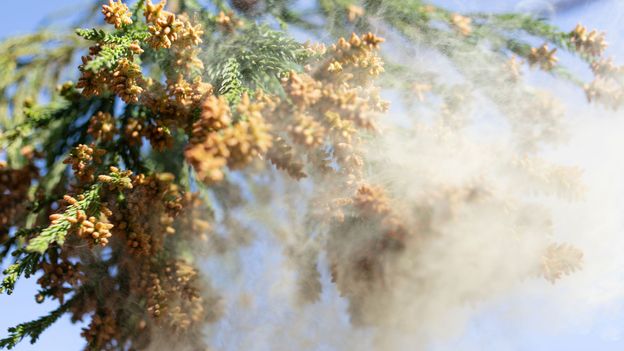
Table of Contents
The Yellow Mist of Spring
In recent years, social media feeds in Japan have been haunted by eerie footage: massive, golden-yellow clouds drifting across the landscape, resembling smoke from a forest fire. But it isn’t smoke. It is pollen—specifically from the Japanese cedar (sugi) and cypress (hinoki)—and for millions of residents, it signals the start of a grueling seasonal battle with hay fever.
What was once considered a manageable nuisance has evolved into a full-scale national health crisis. Allergic rhinitis now affects an estimated 43% of the Japanese population to a medium or severe degree. To put that in perspective, that is nearly double the rate of the United Kingdom and significantly higher than the 12-18% seen in the United States. This isn’t just about sneezing and watery eyes; the societal toll is staggering. At the height of the season, the economic drag from sick days and plummeted consumer spending is estimated to hit $1.6 billion per day.
A Legacy of Post-War Expediency
The root of the problem isn’t a natural ecological shift, but a calculated government decision made seven decades ago. Following the devastation of World War II, Japan faced severe energy shortages. To fuel homes and industry, the nation stripped its mountains of natural forests, leaving the terrain around hubs like Tokyo, Osaka, and Kobe barren and prone to landslides.
In a rush to stabilize the soil and secure a future supply of timber, the government launched a massive, tax-funded afforestation project. The strategy was speed and utility. They chose two fast-growing, native evergreen species: the sugi and the hinoki. These monocultures were planted across millions of hectares, effectively turning one-fifth of Japan’s total land area into a biological factory for pollen.
The timing has now reached a critical tipping point. These trees typically reach their peak pollen production after 30 years of maturity. Since the vast majority of these plantations were planted in the mid-20th century, they have all hit their reproductive prime simultaneously, releasing staggering volumes of lightweight pollen that drift effortlessly into dense urban centers.
The Biodiversity Trade-off
Beyond the health implications, the environmental cost of this legacy is stark. Walking through a sugi or hinoki plantation is a surreal experience; the forests are silent, lacking the birds, insects, and undergrowth found in natural ecosystems. The ground is often a sterile carpet of dry needles, blocking sunlight and preventing other flora from taking root.
This stands in contrast to Japan’s remaining natural forests, which are biodiversity hotspots teeming with red pine, larch, and maple. By prioritizing a a few specific species for industrial gain, Japan accidentally created an ecological desert that now actively harms its citizens.
The Long Road to Diversification
In 2023, the Japanese government finally classified the allergy epidemic as a national social problem. The central government’s current ambition is to reduce pollen levels by 50% over the next 30 years, starting with a goal to cut high-pollen sugi forest areas by 20% by 2033.
However, reversing seven decades of monoculture is a logistical nightmare. Simply clear-cutting the forests would risk triggering the very soil erosion the original project sought to prevent, and it could jeopardize the nation’s carbon neutrality targets. The solution requires a surgical, gradual transition back to broadleaf forests.
Some local initiatives are already providing a blueprint. In Nishiawakura, Okayama, the town has pivoted its economy to manage its 84% hinoki and sugi coverage by converting wood into heat for eel farms and specialty timber. Similarly, the city of Kobe has embarked on a 15-year cycle to convert 180 hectares of plantation back into natural broadleaf forests, selectively removing invasive species to let native seedlings return.
As climate change pushes the spring season earlier, the window for these interventions is shrinking, leaving Japan to grapple with a biological debt that is now coming due.