Unitree Unveils the GDO1: A $650,000 ‘Mecha’ Robot That Smashes Through Walls
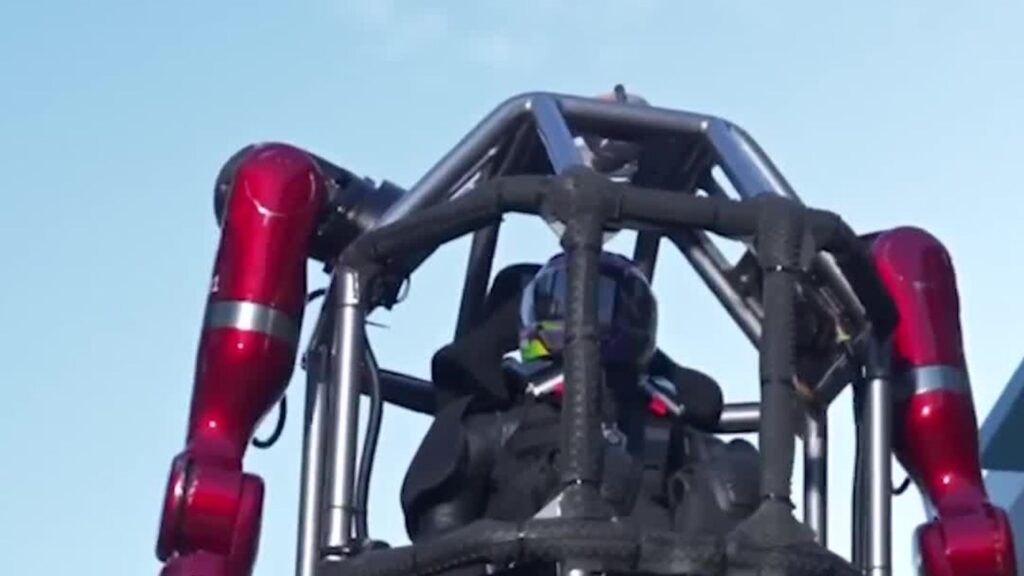
Table of Contents
A departure from the humanoid form
Unitree, the Hangzhou-based robotics firm that has spent the last few years flooding the market with agile, low-cost quadrupeds and humanoids, is pivoting toward the cinematic. The company has just revealed the GDO1, a massive, transforming “mecha” robot that looks less like a lab assistant and more like a prop from a cyberpunk blockbuster. Unlike their G1 humanoid, which aims for human-like utility and accessibility, the GDO1 is an exercise in raw power and mechanical scale.
The reveal came via a high-energy promotional video featuring Unitree founder and CEO Xingxing Wang alongside the machine. The footage isn’t focused on delicate tasks like folding laundry or sorting parcels. Instead, the GDO1 is shown obliterating a wall of cinder blocks in a display of force that feels designed to shock rather than to serve a specific commercial purpose.
Mechanical versatility and the ‘Spider Walk’
The GDO1’s design is characterized by a striking red-and-black aesthetic and a chassis capable of extreme contortion. In the promotional material, the robot is seen shifting its center of gravity and executing a low-profile “spider walk,” a movement that suggests a high level of joint flexibility and torque control. While the video depicts the robot smashing through obstacles seemingly without a pilot, it remains unclear whether the GDO1 is fully autonomous, remotely operated, or a hybrid of both.
This level of mobility is a hallmark of Unitree’s engineering philosophy. The company has already gained notoriety for the G1 humanoid, which has become a favorite among researchers for its ability to perform acrobatic maneuvers and martial arts. By applying that same balance and agility to a much larger, heavier frame, Unitree is attempting to prove that mecha-scale robotics can be more than just static sculptures.
The economics of the Mecha market
The most jarring detail of the announcement is the price tag: $650,000. For the average consumer, that is an impossible sum, but in the world of industrial robotics and high-end research, it’s a strategic placement. To put this in perspective, Unitree has built its brand on being the “budget” alternative to Western robotics. Their entry-level humanoids often start around $15,000, frequently undercutting U.S.-made competitors by a factor of ten.
This pricing advantage is largely attributed to Unitree’s proximity to China’s dense hardware supply chain, allowing them to iterate on sensors, actuators, and battery tech faster and cheaper than almost anyone else. However, the GDO1 isn’t targeting the developer market. At over half a million dollars, it is positioned as a prestige product—a statement piece for tech collectors, themed entertainment venues, or specialized research facilities interested in heavy-load mobility.
Utility vs. Spectacle
There is a palpable tension in the GDO1’s design between practical application and pure spectacle. While the ability to breach walls and traverse difficult terrain has theoretical applications in search-and-rescue or urban demolition, the presentation suggests Unitree is leaning into the “cool factor.” The GDO1 doesn’t come with a list of warehouse KPIs or a manual on how it integrates into a logistics chain; it comes with a video set to thunderous rock music.
Whether the GDO1 ever sees a practical rollout in a commercial setting remains to be seen. For now, it stands as a vivid example of Unitree’s ambition: moving beyond the utility of the quadruped and the curiosity of the humanoid, and stepping directly into the realm of science fiction.


