Clawdmeter Launches: The New ‘Hardware Tamagotchi’ for Claude AI Power Users
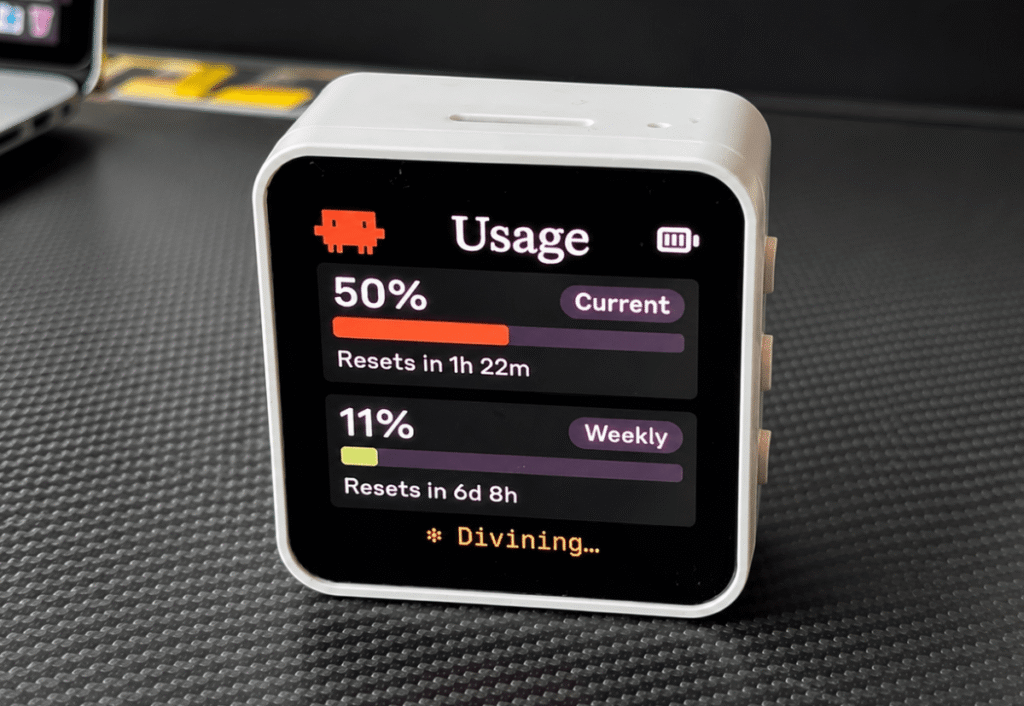
Table of Contents
Clawdmeter Launches: The New ‘Hardware Tamagotchi’ for Claude AI Power Users
The era of “tokenmaxxing” has officially moved from the terminal to the desktop. A new open-source hardware project called Clawdmeter is turning the abstract data of AI consumption into a physical experience, providing developers with a dedicated, pixel-art dashboard to track their Claude Code utilization in real-time.
While most power users are accustomed to tracking token usage through command-line interfaces or external API monitoring tools, the Clawdmeter introduces a layer of gamification to the development process. By transforming technical metrics into a visual “dopamine loop,” the device reflects a growing trend among software engineers to treat AI consumption as a badge of productivity.
- Developer: Hermann Haraldsson (Reykjavik, Iceland)
- Hardware: Waveshare ESP32-S3-Touch-AMOLED-2.16
- Connectivity: Bluetooth Low Energy (BLE)
- Core Function: Real-time Claude Code token tracking & shortcuts
Beyond the Terminal: What is Clawdmeter?
At its core, the Clawdmeter is a specialized display that syncs with a user’s laptop to visualize how much of their Claude Code context window and token quota they are consuming. The project is less about utility—since this data is available in the console—and more about the aesthetic and psychological satisfaction of seeing AI work in a physical form.
The device features a vivid AMOLED screen where a pixel-art “Clawd” sprite dances and reacts to the user’s activity. As the usage rate spikes, the animations become more frantic, creating a visual representation of the AI’s workload. This “hardware Tamagotchi” approach brings a sense of nostalgia to modern Anthropic Claude updates, mimicking the dedicated gadgets of the 90s and 2000s.
The Technical Architecture
The device is powered by the Waveshare ESP32-S3-Touch-AMOLED, a compact module that balances power efficiency with a high-quality display. To fetch usage data, the Clawdmeter reads the user’s Claude Code OAuth token, making precise API calls and extracting utilization numbers directly from the response headers.
Beyond simple monitoring, the device doubles as a physical controller. It includes two dedicated side buttons that send Space and Shift+Tab commands over Bluetooth, allowing users to toggle Claude Code’s voice mode or switch between Normal, Plan, and Auto modes without leaving their keyboard.
Why Tokenmaxxing is Becoming a Trend
The rise of projects like Clawdmeter highlights a curious cultural shift in Silicon Valley: “tokenmaxxing.” In this context, software engineers are increasingly viewing high token consumption not as a cost, but as a metric of how deeply they have integrated AI into their workflow.
This shift signifies the transition of AI from a simple “chat bot” to a core infrastructure component. When developers maximize their token usage, they are essentially maximizing the amount of codebase the AI can process, leading to faster refactoring and more complex autonomous coding tasks. This aligns with broader AI smartphone comparisons and productivity tool trends where the volume of AI interaction correlates with efficiency.
Hardware Specifications and Build
Because the project is open-source, anyone with basic electronics knowledge can assemble their own version. The use of a lithium-ion battery makes the device portable, while the Bluetooth pairing ensures it doesn’t clutter the workspace with cables.
| Component | Specification |
|---|---|
| Display | 2.16″ Touch AMOLED |
| Microcontroller | ESP32-S3 |
| Connection | Bluetooth (BLE) |
| Power | Rechargeable Li-ion Battery |
| Inputs | Touchscreen + 3 Physical Buttons |
The Impact of AI on Democratized Hardware
One of the most compelling aspects of the Clawdmeter’s origin is how it was built. Developer Hermann Haraldsson admitted he was not an embedded systems expert. Instead, he used Claude to guide him through the hardware selection and coding process over several days.
This exemplifies the “democratization of programming.” By using AI coding guides and LLM-driven troubleshooting, non-specialists can now prototype complex hardware-software integrations that previously required years of specialized study. The result is a surge in “hobbyist-pro” gadgets that fill niche needs in the developer ecosystem.
What Happens Next for the Clawdmeter?
Since its launch on May 10, the project has gained significant traction on GitHub, with hundreds of stars and dozens of forks. The community is already suggesting new features, including “top-up” buttons for credit and expanded animation libraries for different AI models.
As AI agents become more autonomous, we can expect a new wave of “Agentic Hardware”—physical devices that act as monitors or controllers for the AI agents running in the background of our OS. The Clawdmeter is likely just the first of many such devices that will turn the invisible process of token consumption into a tangible desktop presence.
Source: Project documentation via GitHub and interviews with developer Hermann Haraldsson.