Home / AI Agents 2026: How Autonomous AI is Transforming Work and Business
AI Agents 2026: How Autonomous AI is Transforming Work and Business
swa | April 13, 2026 | 9 min read
Table of Contents
Something just started happening – tasks that once required human attention began completing themselves. Reports got drafted. Emails were triaged. Research happened while you slept. That shift has a name: AI agents 2026 represents the tipping point where artificial intelligence stopped being a tool you use and became a colleague that acts.
If you have been watching the hype and waiting for the real story, this is it.
What Are AI Agents? The 2026 Definition
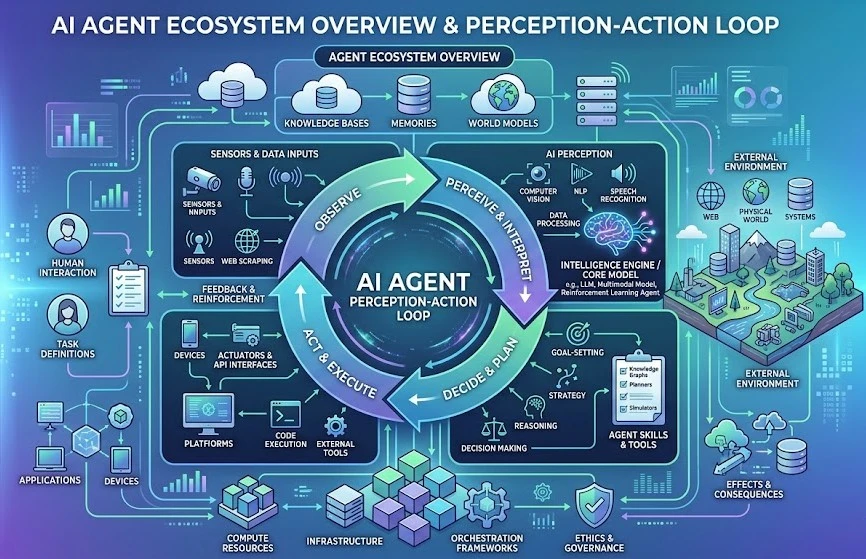
A traditional software program follows instructions. An AI agent follows intentions. Feed it a goal and it decides how to break that into steps, which tools to use, how to handle unexpected obstacles, and when the job is done well enough to stop.
The technical anatomy of an agent involves four building blocks that have matured significantly by 2026:
- Perception: The agent ingests data from the world — documents, APIs, databases, web pages, email inboxes, and sensor streams.
- Reasoning: A large language model (LLM) at the core processes that context and produces a plan.
- Action: The agent executes steps using tool calls running code, querying databases, sending messages, browsing the web, or calling external APIs.
- Memory: Short-term context windows and long-term vector stores let agents remember prior interactions and build persistent knowledge.
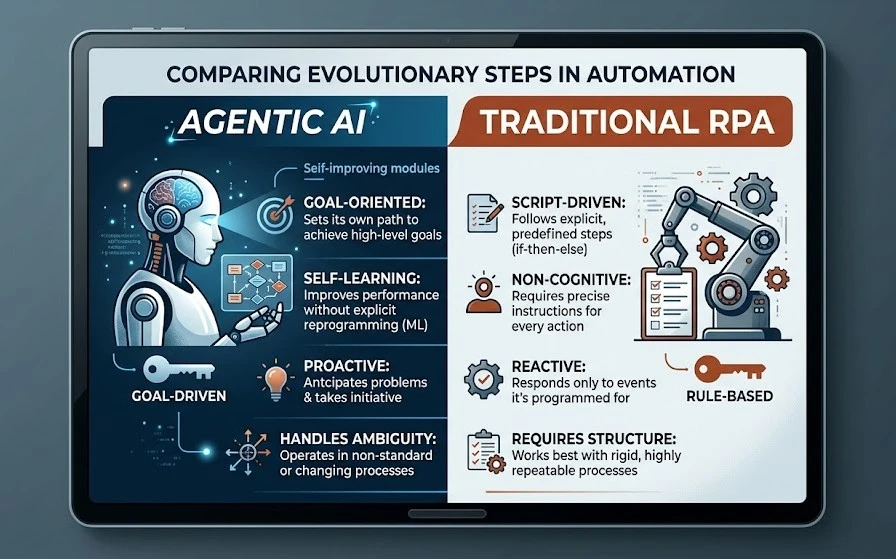
Agentic AI vs. Traditional Automation
Traditional robotic process automation (RPA) breaks the moment a web form changes its layout. Agentic AI adapts. It reads the new form, figures out the field mapping, and carries on. This resilience is what makes autonomous AI tools genuinely different from the scripted bots of the 2010s.
The State of AI Agents in 2026: A Market in Full Sprint
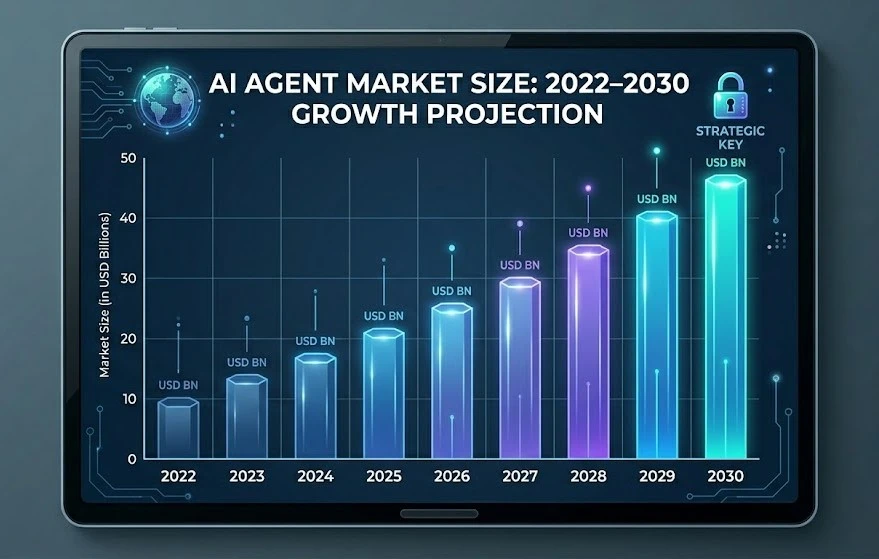
The numbers are difficult to ignore. The global AI agents market, valued at approximately $5.1 billion in 2024, is projected to surpass $47 billion by 2030 — a compound annual growth rate of more than 44%, according to MarketsandMarkets. That trajectory has not slowed. If anything, the entry of major platform vendors has accelerated enterprise adoption.
Key Milestones Reached in 2025–2026
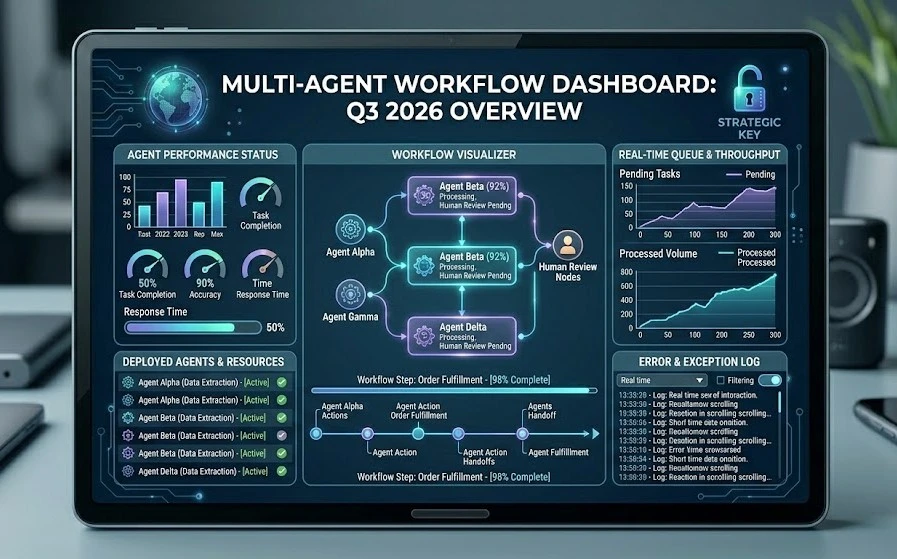
- Multi-agent orchestration became mainstream: frameworks like LangGraph, AutoGen, and CrewAI enable teams of specialized agents to collaborate on complex tasks, handing off work like a relay race.
- Tool-use reliability crossed the threshold: Top models now successfully complete multi-step tool-call chains with accuracy rates above 90% on standardized benchmarks, compared to 60–70% just 18 months ago.
- Memory architectures matured: Persistent memory systems mean agents can recall previous conversations, user preferences, and organizational context across sessions — a critical requirement for enterprise use.
- Regulation caught up (partially): The EU AI Act’s agentic provisions took effect in early 2026, requiring transparency disclosures and human oversight mechanisms for high-risk autonomous AI deployments.
How AI Agents Actually Work: Under the Hood
Understanding the mechanics helps separate the capable from the overhyped. At its core, an AI agent runs a loop called the ReAct cycle (Reasoning + Acting), a pattern formalized in research at Google DeepMind and widely adopted by 2025.
Here is a simplified version of what happens when you assign an agent to book a meeting with three stakeholders:
- Observe: The agent reads your calendar, the stakeholders’ shared availability, your email history with each person, and any stated preferences in your profile.
- Think: The LLM reasons about the constraints and drafts a plan: find overlapping slots, cross-reference with meeting room availability, draft a professional invite.
- Act: It calls the calendar API to block the slot, the email API to send invitations, and optionally the Slack API to notify the team.
- Evaluate: It checks whether calendar holds were confirmed and invites sent. If one stakeholder’s calendar access fails, it retries with an email fallback.
The Role of Memory and Context
One of the underappreciated advances of 2026 is long-context memory. Early agents were amnesiac — every session started fresh. Modern agents maintain episodic memory (what happened in past conversations), semantic memory (facts about your organization), and procedural memory (how you prefer tasks to be done). This transforms them from useful tools into genuinely knowledgeable collaborators.
Multi-Agent Systems: When One Is Not Enough
Complex workflows now routinely use agent teams. A research pipeline might use a ‘planner’ agent to decompose a query, a ‘search’ agent to retrieve sources, a ‘synthesis’ agent to write the draft, and a ‘fact-check’ agent to verify claims before output. This division of labor mirrors how human teams operate — and it is already running inside companies like Klarna, Duolingo, and Goldman Sachs.
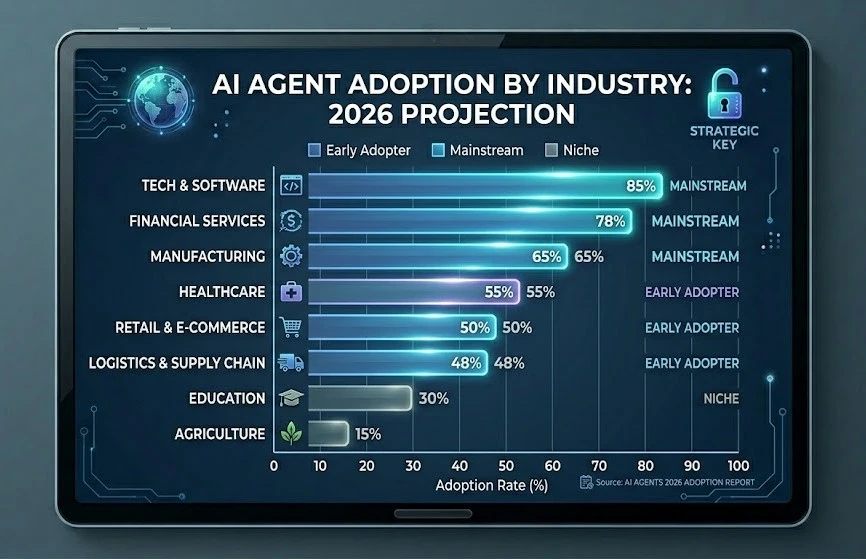
Industry Impact: Where AI Workflow Automation Is Landing
Autonomous AI is not a horizontal technology with uniform impact. Its effect varies sharply by industry — and the leaders are already building durable competitive advantages.
Financial Services
JP Morgan Chase deployed an AI agent system in 2025 that reduced document review time for loan applications by 60%. Goldman Sachs uses agentic AI to monitor thousands of data feeds simultaneously, flagging anomalies that human analysts would take days to spot. Compliance workflows — traditionally slow, labor-intensive, and expensive — are a particularly strong fit for AI workflow automation.
Healthcare
In clinical settings, AI agents are accelerating prior authorization processes, one of the most time-consuming administrative burdens in US healthcare. Olive AI and Abridge have deployed agents that reduce the average prior auth cycle from 16 days to under 72 hours. Patient scheduling, insurance verification, and clinical documentation are now routinely handled by agentic systems at scale.
Software Development
Developer productivity is perhaps the most tangible and measurable impact of agentic AI. GitHub’s research in 2025 found that developers using AI coding agents (not just autocomplete, but full agentic task execution) completed tasks 55% faster. Entire categories of work — bug triage, test generation, dependency updates, code review — are now delegated to agents running in CI/CD pipelines.
Real-World Examples: AI Agents in Action
Klarna: Replacing 700 FTE Equivalents
Klarna’s AI-powered support agent, built on OpenAI’s platform, handled 2.3 million customer conversations in its first month — work previously equivalent to 700 full-time employees. Notably, customer satisfaction scores were equal to or better than human agent benchmarks. Klarna reinvested the efficiency gains into premium customer service for complex cases.
Cognition's Devin: The Autonomous Software Engineer
Devin, launched by Cognition in 2024 and widely adopted through 2025, is a fully autonomous software engineering agent. It can take a GitHub issue, write the fix, add tests, open a pull request, and respond to review comments — without human intervention at each step. It represents the most visible proof point that agentic AI has crossed from demonstration into practical deployment.
Salesforce Agentforce: Enterprise CRM Goes Autonomous
Salesforce’s Agentforce platform allows companies to deploy custom AI agents directly inside their CRM workflow. A sales agent, for example, can identify at-risk accounts, draft personalized outreach, schedule follow-ups, and update opportunity records — all triggered by data signals, not manual input. Early customers reported a 30% improvement in pipeline hygiene within the first quarter of deployment.
Challenges and Controversies: The Honest Assessment
Enthusiasm for AI agents is real — and so are the problems. Deploying autonomous AI tools at scale surfaces issues that polished demos carefully avoid.
Hallucination and Reliability
Agents that take real-world actions based on incorrect reasoning cause real-world problems. A coding agent that introduces a subtle security vulnerability, or a scheduling agent that double-books a critical meeting, erodes trust quickly. The field has made progress — constrained tool-use, retrieval-augmented generation, and verification loops all reduce failure rates — but reliability remains an active research and engineering challenge.
Security and Prompt Injection
Prompt injection — where malicious content in the environment hijacks an agent’s instructions — is a significant attack surface. An agent browsing the web can be instructed by a compromised page to exfiltrate data or take unauthorized actions.
The Jobs Question
The jobs impact of agentic AI is real but more nuanced than ‘robots are taking everything.’ McKinsey’s 2025 analysis found that the tasks most at risk are repetitive, process-driven knowledge work — data entry, basic analysis, document drafting, and customer service routing. Roles requiring judgment, relationship management, and creative problem-solving are proving more resilient. The more accurate framing may be task displacement rather than job elimination — but for workers in affected roles, the distinction matters less than the outcome.
Future Outlook: Where Agentic AI Goes From Here
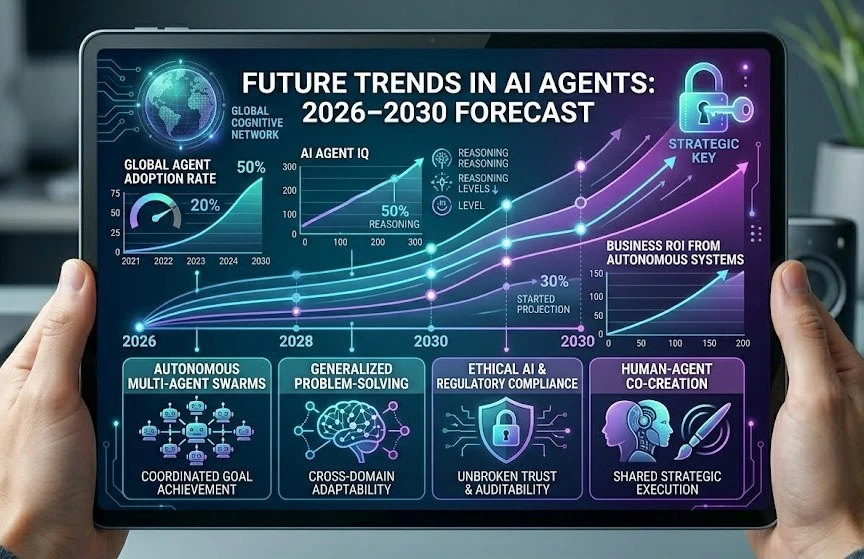
The trajectory of AI agents 2026 points toward three converging developments that will define the next chapter.
Persistent, Proactive Agents
Today’s agents are largely reactive — they act when prompted. The near-term roadmap includes agents that operate continuously in the background, proactively surfacing opportunities and risks without being asked. Think of it as the difference between a contractor who shows up when called and a chief of staff who is always watching the horizon.
Agent-to-Agent Economies
Research labs and startups are building infrastructure for agents to hire other agents — paying for capabilities in real time using micro-payment rails. An agent managing a marketing campaign might autonomously contract a design agent, a data analysis agent, and a scheduling agent to complete a project. This creates an emerging marketplace of specialized AI capabilities.
Embodied AI Agents
The next frontier is physical: AI agents controlling robots in warehouses, hospitals, and construction sites. Figure AI and Boston Dynamics are at the forefront of this convergence. By 2028, the distinction between ‘AI agent’ (software) and ‘AI robot’ (hardware) will be largely semantic — both will share the same underlying architecture.
Final Thoughts: The Autonomous Shift Is Already Here
AI agents 2026 are not a coming attraction. They are in your industry’s supply chain, your competitor’s customer service team, and quite possibly already inside tools you use every day. The question is not whether autonomous AI tools will change how work gets done it already is. The question is whether you are building the understanding and organizational capability to use that shift to your advantage. The most important thing to grasp is that this is not about replacing human judgment. It is about removing the friction between human intent and real-world outcomes.
FAQs
1. What are AI agents?
AI agents are software systems that perceive their environment, reason about goals, and take sequences of actions to accomplish tasks — often without requiring step-by-step human instruction.
2. How do AI agents work?
AI agents work by utilizing a central Large Language Model (LLM) to perceive their environment, reason through problems, generate plans, and execute actions using external tools.
3. Are AI agents replacing jobs?
AI agents are automating specific tasks rather than entire job functions. Roles involving repetitive process-driven work face the most disruption. Jobs requiring strategic judgment, creative problem-solving, and relationship management are proving more resilient. The transition is best understood as task displacement, requiring workforce adaptation rather than wholesale job replacement.
4. What are examples of AI agents?
Current real-world examples include Cognition’s Devin, Klarna’s customer service agent, Salesforce Agentforce, GitHub Copilot Workspace, and healthcare agents for prior authorization and clinical documentation.
5. How can I use AI agents in my business?
Start with well-defined, high-volume, process-driven tasks — document review, lead qualification, content drafting, support routing. Use established platforms like Microsoft Copilot Studio, Salesforce Agentforce, or cloud provider frameworks. Establish clear human oversight checkpoints for consequential actions, and implement logging and audit trails from day one.



There is definately a lot to find out about this subject. I like all the points you made